I love a beautiful garden, but I don’t love the idea of spending every spare hour weeding, watering, pruning, feeding, mowing and generally trying to stop everything from turning into a jungle.
The good news is that a thriving garden doesn’t have to be a high-maintenance garden.
In fact, some of the healthiest and most attractive gardens I’ve seen are the ones that work with nature rather than against it. The plants are suited to the conditions, the soil is protected, watering is kept sensible and there aren’t endless fussy jobs demanding attention every weekend.
If you’re creating a new garden or simply want to make your existing one easier to manage, these are my top 10 low maintenance gardening tips.
1. Choose Plants That Actually Like Your Garden
This is probably the single biggest thing I’ve learned about creating an easier garden.
It’s tempting to buy plants simply because they look beautiful at the garden centre. But if that plant needs completely different conditions from the ones you can provide, you’re potentially signing yourself up for years of extra work.
Before planting anything, think about:
How much sun the area receives
Whether your soil is dry or moisture-retentive
How freely the soil drains
Your local climate
How exposed the garden is to wind
How much space the mature plant will eventually need
A plant that’s naturally suited to its position normally needs much less watering, feeding, protecting and rescuing.
If you’ve got a hot, sunny and dry border, for example, plants such as lavender, sedum, yarrow and ornamental grasses may be far easier to look after than plants that constantly want moist soil.
Likewise, don’t fight a shady corner. Choose shade-loving plants and make the conditions work in your favour.
Low-maintenance rule: Don’t try to change your entire garden to suit a plant. Choose plants that already suit your garden.
2. Plant More Perennials and Fewer Annuals
Annual bedding plants can look fantastic, but they usually have to be replanted every year.
That means more buying, planting, watering and general maintenance.
Perennials, on the other hand, come back year after year. Once they’re established, many need surprisingly little attention.
Some reliable perennial choices include:
Coneflowers
Hostas
Hardy geraniums
Sedum
Daylilies
Salvia
Heuchera
Black-eyed Susans
Yarrow
Catmint
You don’t have to eliminate annuals completely. I still think they’re brilliant for filling containers or adding quick seasonal colour.
I’d simply use them as accents rather than making them the backbone of the garden.
Shrubs are another fantastic low-maintenance option. A few well-chosen evergreen and flowering shrubs can provide structure for years without needing constant attention.
3. Cover Bare Soil With Mulch
Bare soil is basically an invitation for weeds.
Whenever I want to make an area of the garden easier to manage, one of the first things I think about is mulch.
A layer of mulch can help:
Suppress weeds
Slow moisture loss
Protect the soil surface
Moderate soil temperatures
Gradually improve soil when organic materials are used
Materials such as compost, shredded bark, wood chips and leaf mould can all work well depending on the area.
Generally, a layer several inches deep is much more effective than sprinkling a tiny amount over the surface.
Just avoid piling mulch directly against plant stems, shrub trunks or tree trunks, where excessive moisture can cause problems.
Mulching is one of those garden jobs where a little effort upfront can save an enormous amount of work later.
4. Plant Closely Enough to Crowd Out Weeds
Another way to reduce weeds is simply to give them less room to grow.
A border filled with healthy plants naturally shades much of the soil underneath. Less light reaches weed seedlings, and there is less open ground available for them to colonise.
Ground-cover plants are particularly useful.
Depending on your garden conditions, you could try plants such as:
Creeping thyme
Hardy geraniums
Ajuga
Pachysandra
Epimedium
Lamb’s ear
Heuchera
The aim isn’t to cram plants together so tightly that they compete excessively. Follow sensible planting distances and remember how large each plant will eventually become.
But equally, don’t leave huge areas of empty soil unless that’s part of your design.
A mature, well-planted border usually becomes considerably easier to manage.
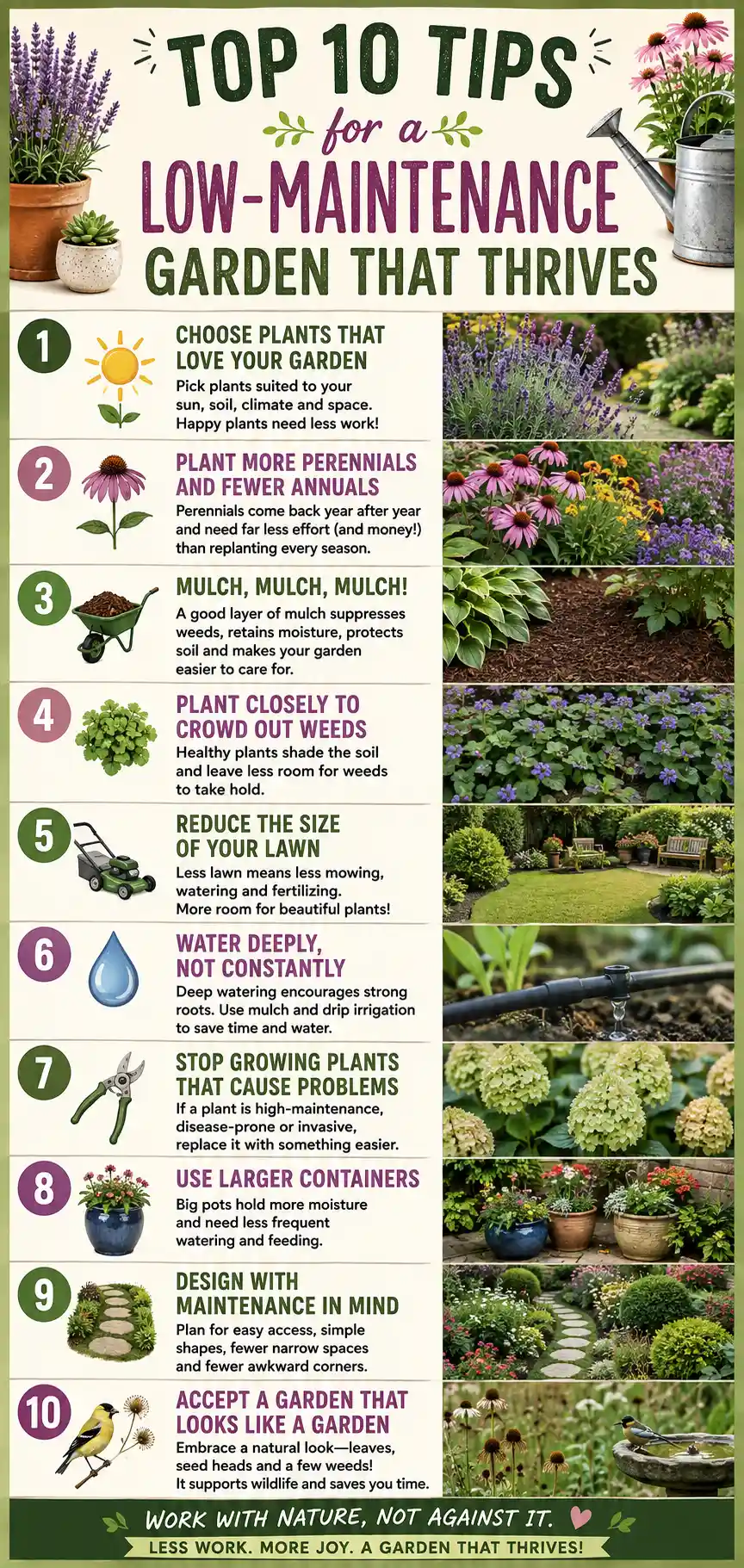
5. Reduce the Size of Your Lawn
Lawns often look simple, but they’re one of the most demanding parts of many gardens.
Think about everything involved:
Mowing.
Edging.
Watering.
Feeding.
Weeding.
Overseeding.
Dealing with bare patches.
Removing leaves.
Trying to keep the whole thing green during hot weather.
If you enjoy caring for your lawn, there’s absolutely nothing wrong with keeping it.
But if you’re trying to create a lower-maintenance garden, reducing the amount of lawn can make a huge difference.
You could replace portions of it with:
Larger flower beds
Shrub borders
Gravel
Ground-cover plants
Paths
Patio areas
Wildflower areas
Raised beds
Even changing an awkward narrow strip of lawn into a planted border can remove a frustrating mowing job.
And if you do keep a lawn, simple shapes are usually easier to mow than intricate curves, tiny corners and narrow strips.
6. Water Deeply Rather Than Constantly
Frequent shallow watering can encourage plants to develop shallow root systems.
I prefer giving established plants a thorough drink when they actually need it rather than providing tiny amounts of water every day.
Deep watering encourages moisture to penetrate further into the soil, where roots can follow it.
There are exceptions, of course. Newly planted flowers, vegetables, seedlings and containers may need more frequent watering while they’re establishing.
Once plants become established, however, many can cope with much longer gaps between watering.
You can make the job even easier by installing:
Drip irrigation
Soaker hoses
Automatic watering timers
Rain barrels
Larger water butts or rainwater harvesting systems
Watering early in the morning can also reduce evaporation compared with watering during the hottest part of the day.
And remember: mulch is your friend here too. Mulched soil generally retains moisture far better than exposed soil.
7. Stop Growing Plants That Constantly Cause Problems
This might sound slightly ruthless, but I think it’s one of the most useful low-maintenance gardening lessons.
If one particular plant repeatedly needs spraying, staking, protecting, rescuing, treating for disease or replacing, ask yourself whether it’s really worth keeping.
Gardening should involve some work. That’s part of the pleasure.
But you don’t have to spend years battling one plant that clearly doesn’t want to grow where you’ve put it.
If something repeatedly struggles, I usually consider replacing it with a tougher alternative.
The same applies to plants that:
Spread aggressively
Need constant deadheading
Flop without staking
Attract recurring pest problems
Need frequent dividing
Require complicated pruning
There are thousands of wonderful plants available.
Choose the ones that make your gardening life easier.
8. Use Larger Containers
I love container gardening, but small pots can become surprisingly demanding.
They dry out quickly, need frequent watering and often require regular feeding because nutrients wash through the compost.
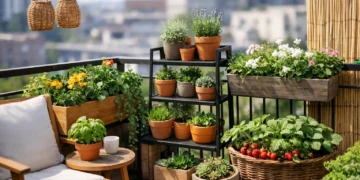
If you like container displays but want less work, choose fewer large containers rather than dozens of tiny ones.
Larger containers hold more compost and moisture, so they generally don’t dry out as quickly.
You can also group several compatible plants together in one large pot.
For example, you might create a container with:
One structural plant
One flowering perennial
One trailing plant
You’ll get plenty of visual impact without having to care for ten individual pots.
Self-watering containers can also be extremely useful, particularly if you’re frequently away from home.
9. Design Your Garden With Maintenance in Mind
Garden design isn’t only about appearance.
It can determine how much work you’ll be doing for years.
When planning a low-maintenance garden, I think about practical questions such as:
Can I easily reach the plants?
Very deep borders can make pruning and weeding difficult unless you include stepping stones or access paths.
Can I easily mow the lawn?
Trees planted randomly in the middle of a lawn can create awkward obstacles.
Do I have narrow strips of grass?
These can be tedious to mow.
Are there dozens of little pots to water?
Consolidating them can save a surprising amount of time.
Are my paths wide enough?
Good access makes everything from carrying compost to pruning shrubs easier.
Simple shapes and generous planting areas usually create a garden that’s easier to maintain than one filled with complicated edges and tiny disconnected spaces.
10. Accept a Garden That Looks Like a Garden
Perhaps the biggest secret to low-maintenance gardening is changing our expectations slightly.
A garden is a living ecosystem.
Leaves fall.
Flowers fade.
Plants grow into each other.
Insects appear.
Birds scratch around.
Moss grows.
A few weeds inevitably pop up.
Personally, I think gardens can become far more enjoyable when we stop expecting them to look perfectly manicured every single day.
Leaving some seed heads over winter, for example, can provide food for birds while adding structure to borders.
Allowing a little leaf litter beneath shrubs creates habitat for insects and gradually adds organic matter to the soil.
Letting plants fill out naturally can reduce the amount of pruning and exposed soil.
There’s a big difference between a neglected garden and a relaxed, natural-looking garden.
Low maintenance doesn’t mean doing nothing.
It means concentrating your effort where it actually makes a difference.
A Few More Easy Ways to Reduce Garden Maintenance
There are plenty of smaller changes that can help too.
Avoid Too Many Different Plants
Planting several of the same plant together often looks better and makes maintenance easier.
Instead of caring for 40 different varieties with 40 different requirements, repeat a smaller number of dependable plants throughout the garden.
Choose Slow-Growing Shrubs
Fast-growing hedges may provide privacy quickly, but they can also create endless pruning jobs.
Slower-growing shrubs often need far less attention.
Install Good Edging
A clear physical edge between lawns and borders reduces the amount of time spent trimming and reshaping edges.
Compost Garden Waste
Composting turns leaves, plant trimmings and kitchen scraps into useful soil conditioner while reducing waste.
Once you have a simple composting system in place, it becomes one of the easiest gardening habits to maintain.
Grow Fewer High-Maintenance Vegetables
If you enjoy growing food but don’t want a vegetable garden that becomes a second job, concentrate on crops you actually enjoy eating.
Herbs, salad leaves, zucchini, chard and tomatoes can provide plenty of produce without needing a huge plot.
What Does a Low Maintenance Garden Actually Look Like?
There’s no single style.
A low-maintenance garden might be a modern space filled with ornamental grasses and large areas of gravel.
It could be a cottage-style garden packed with tough perennials.
It might be a wildlife garden with native plants, wildflower areas and a pond.
Or it could simply be a conventional backyard with a smaller lawn, wider borders and easier plants.
The important thing isn’t how it looks.
It’s how well the garden works for you.
Think about which gardening jobs you enjoy and which you hate.
If you love planting but dislike mowing, shrink the lawn.
If you enjoy growing vegetables but hate weeding, try raised beds with mulched paths.
If watering drives you mad every summer, choose drought-tolerant plants and install drip irrigation.
Your garden should suit the amount of time and energy you realistically want to give it.
My Low Maintenance Garden Checklist
If you’re trying to simplify your garden, I’d start with these basics:
Choose plants suited to your soil and light
Grow plenty of perennials and shrubs
Mulch exposed soil
Use ground-cover plants
Reduce unnecessary lawn
Water deeply rather than little and often
Remove consistently troublesome plants
Choose larger containers
Keep paths and borders easy to access
Allow your garden to look naturally alive
You don’t have to do everything at once.
Even making two or three of these changes can noticeably reduce the amount of work your garden requires.
Final Thoughts
For me, low-maintenance gardening isn’t about trying to avoid gardening altogether.
It’s about avoiding unnecessary gardening.
I’d much rather spend an hour planting something new, harvesting vegetables or simply enjoying the garden than spend that same hour repeatedly fighting weeds, watering unsuitable plants or mowing awkward pieces of lawn.
The easiest gardens tend to become easier with time.
Shrubs mature. Perennials spread. Ground-cover plants fill gaps. Mulch improves the soil. Roots become deeper and plants become better established.
Eventually, the garden begins doing much of the work itself.
And that’s really the goal: a garden that looks beautiful, supports wildlife, grows happily and still leaves you enough time to sit down and enjoy it.
See also: Transform Your Space with Low Maintenance Garden Ideas >