If you’ve ever watered a houseplant only to see a cloud of tiny black flies suddenly appear from the compost, there’s a very good chance you’ve met fungus gnats.
They are one of those houseplant problems that can drive you slightly mad. You swat a few, put out a sticky trap and think you’ve finally got rid of them – then a few days later they seem to be back again.
The reason is simple: the little flies you can see are only part of the problem.
Most of the fungus gnat population is actually hidden away in the potting mix as eggs, larvae and pupae. So, if you want to get rid of fungus gnats properly, you need to tackle what is happening inside the soil as well as above it.
Learn more about Pest and Disease Management >
Fortunately, fungus gnats are usually much more annoying than dangerous, and once you understand their life cycle they are relatively straightforward to control.
What Are Fungus Gnats?
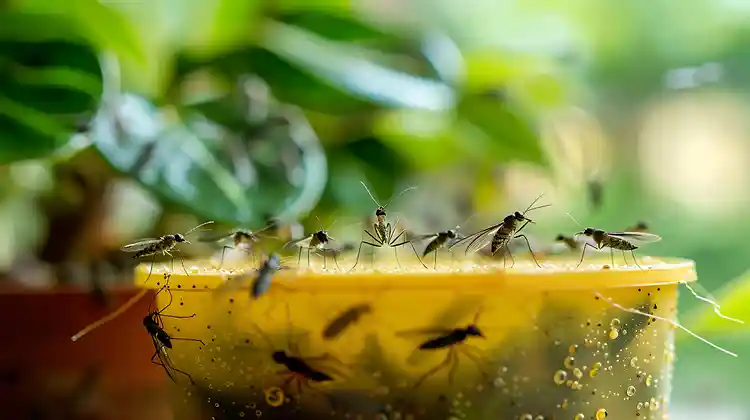
Fungus gnats are tiny dark flies commonly found around houseplants, seed trays, greenhouses and other places where potting soil remains damp.
They belong to several groups of small flies, with Bradysia species being particularly common around houseplants.
Adult fungus gnats are usually only around 1/16 to 1/8 inch long.
They have:
Dark gray or black bodies
Long legs
Long antennae
Clear wings
A slightly mosquito-like appearance
They are weak fliers, so instead of buzzing quickly around the room like fruit flies, you’ll often see fungus gnats wandering across the compost or making short, slightly erratic flights around plant pots.
You may also notice them gathering near windows.
Adult fungus gnats don’t bite people and generally don’t feed on our plants either. Their main purpose during their short adult lives is reproduction.
The larvae are the stage that lives in the compost.
What Do Fungus Gnat Larvae Look Like?
Fungus gnat larvae are much harder to spot than the adults.
They are:
Tiny
Almost transparent or whitish
Worm-like
Legless
Usually identifiable by a small black head
Most larvae live close to the surface of the compost, often within the upper few inches.
They mainly feed on fungi, algae and decomposing organic material in the soil.
However, they can also feed on delicate plant roots and root hairs. Large populations are therefore more concerning for seedlings, cuttings and young plants with small root systems.
Established houseplants will usually tolerate relatively small numbers without serious damage.
Why Do I Have Fungus Gnats?
There is one condition fungus gnats particularly love:
Damp potting soil.
If compost stays constantly moist, you’ve created almost perfect fungus gnat conditions.
Female gnats are attracted to moist growing media where they lay their eggs.
The problem is therefore especially common when:
Houseplants are watered too frequently
Pots have poor drainage
Water remains in saucers or decorative outer pots
Potting compost contains lots of moisture-retaining organic material
Dead plant material is sitting on the soil
Plants are growing in old, compacted compost
Indoor plants are watered just as frequently in winter as they are in summer
That last point is particularly important.
Plants generally use less water when light levels and temperatures fall. If we keep watering according to our summer schedule, the compost can remain wet for much longer.
Colorado State University Extension notes that fungus gnats are particularly attracted to moist growing media and that allowing the upper 1–2 inches to dry can significantly reduce their survival.
Fungus Gnats vs Fruit Flies
One of the easiest mistakes to make is assuming fungus gnats are fruit flies.
Although both are tiny flying insects found indoors, they tend to appear in different places.
Fungus gnats
Usually found:
Around houseplants
Walking across potting soil
Emerging from compost when plants are watered
Around windows near plants
Fruit flies
Usually found:
Around fruit bowls
Near overripe produce
Around food waste
Near garbage or recycling bins
Around drains containing organic residue
If the flies seem to be coming directly from your plant pots, fungus gnats are the more likely culprit.
Are Fungus Gnats Harmful to Plants?
Usually, not very.
For most established houseplants, fungus gnats are primarily a nuisance rather than a serious pest.
University of Minnesota Extension describes them as scavengers whose larvae feed largely on fungi and decaying roots and notes that they rarely cause significant damage to indoor plants.
However, very large populations can become troublesome.
Larvae may feed on fine roots and root hairs, which can be more damaging to:
Seedlings
Newly rooted cuttings
Young plants
Recently repotted plants
Already stressed or weakened plants
Seedlings are particularly vulnerable because they don’t have a large established root system.
If mature plants are declining badly while fungus gnats are present, it’s also worth considering whether overwatering or root rot is the bigger underlying problem.
The fungus gnats may simply be taking advantage of the same wet compost.
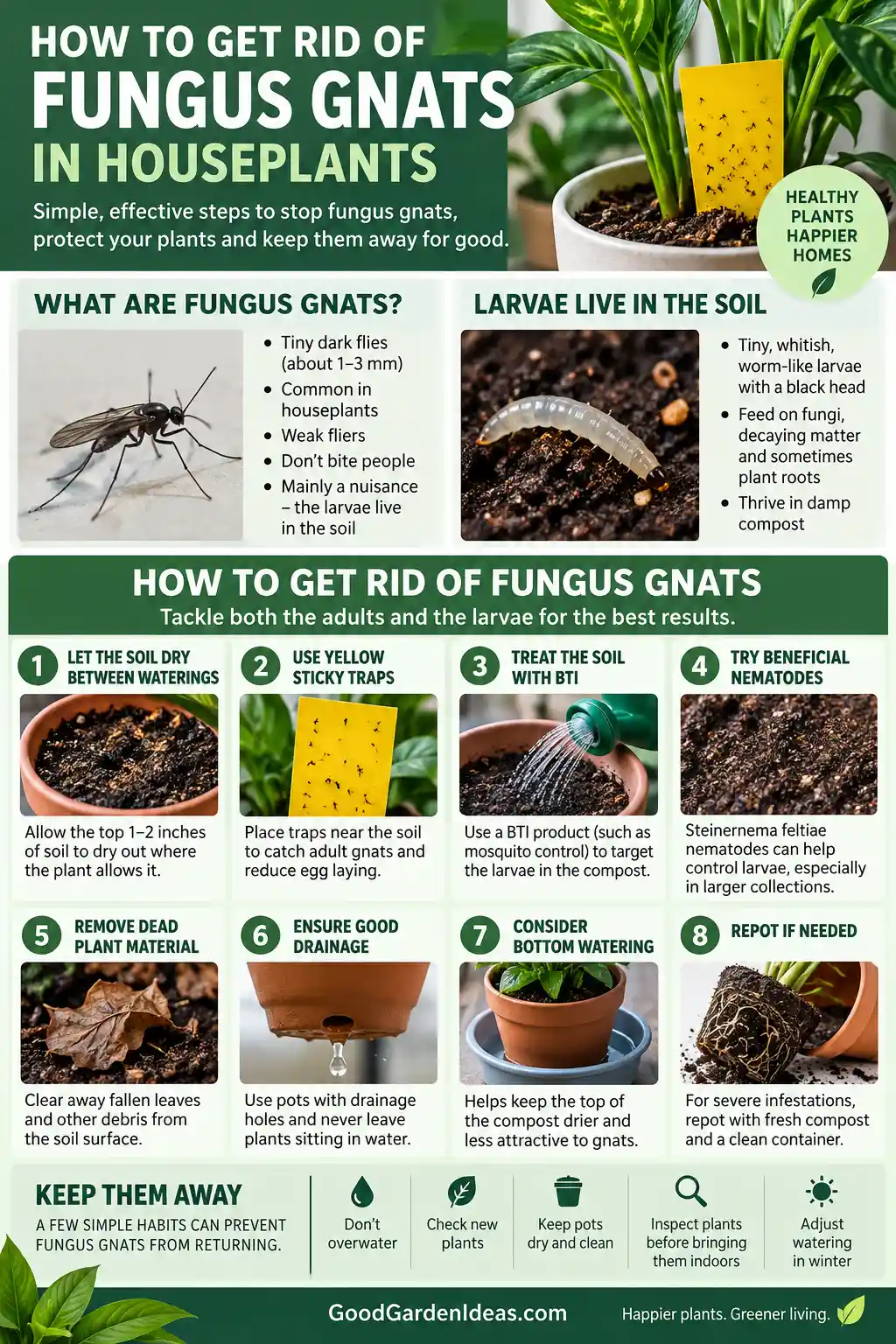
How to Get Rid of Fungus Gnats
The best fungus gnat control isn’t usually one miracle treatment.
I prefer to tackle the problem from several directions at once.
The aim is to:
Make the compost less attractive for egg laying.
Reduce the number of larvae in the soil.
Catch adult gnats before they can produce another generation.
Here’s how.
1. Let the Compost Dry Between Waterings
This is the most important step.
Fungus gnat eggs and larvae depend heavily on moisture.
Allow the upper layer of potting compost to dry before watering again whenever the plant’s growing requirements allow it.
For many common houseplants, allowing roughly the top 1–2 inches to dry is perfectly reasonable.
Don’t deliberately dehydrate plants that naturally require consistently moist soil, but many of us water our houseplants more frequently than they actually need.
Instead of watering according to the calendar, check the compost first.
Push a finger into the soil.
If it still feels moist beneath the surface, leave it another day or two.
This one change can make a surprisingly large difference because drier surface compost is less attractive to egg-laying females and less suitable for developing larvae.
2. Put Out Yellow Sticky Traps
Yellow sticky traps are one of the simplest fungus gnat controls.
Place them:
Just above the soil surface
Along the edge of the pot
Under the foliage
Adult fungus gnats are attracted to the yellow surface and become trapped.
Sticky traps serve two useful purposes.
Firstly, they reduce the number of adult females available to lay eggs.
Secondly, they give you a useful way of monitoring the infestation.
If your traps gradually start catching fewer gnats, you know your treatment is working.
However, sticky traps shouldn’t be used on their own.
They catch the adults but won’t kill the larvae already growing inside the compost. University of Minnesota Extension specifically advises against relying on sticky traps as the sole control method.
3. Treat the Larvae With BTI
For persistent fungus gnats, one of the most useful biological controls is BTI.
BTI stands for:
Bacillus thuringiensis subsp. israelensis
It is a naturally occurring bacterium used to control certain fly and mosquito larvae.
When an appropriate BTI product is applied to the potting medium, fungus gnat larvae ingest it.
The treatment targets the larval stage rather than adult flies.
This is important because killing larvae interrupts the fungus gnat life cycle rather than simply catching the flies you can already see.
Look for a BTI product specifically labeled for the intended use and follow the manufacturer’s instructions.
University of Minnesota Extension lists BTI applied to the soil as a management option specifically targeting fungus gnat larvae.
4. Try Beneficial Nematodes
If you’ve got fungus gnats across a large houseplant collection, beneficial nematodes are another excellent option.
The species you’re looking for is generally:
Steinernema feltiae
These microscopic beneficial organisms are mixed with water and applied to the soil.
They seek out susceptible insect larvae in the growing medium.
Colorado State University Extension identifies Steinernema feltiae as particularly effective against fungus gnat larvae.
Nematodes are especially useful for:
Large plant collections
Indoor growing rooms
Greenhouses
Seedling production
Persistent infestations
Follow the supplier’s instructions carefully because beneficial nematodes are living organisms and storage and application conditions matter.
5. Remove Dead Plant Material
Have a look at the surface of your pots.
Remove:
Dead leaves
Fallen flowers
Rotting stems
Decaying roots
Dead moss
Other decomposing material
Fungus gnat larvae feed heavily on fungi and decaying organic matter.
Removing unnecessary material reduces their food supply and makes your pots less hospitable.
6. Empty Plant Saucers
Never leave your plants standing permanently in water.
After watering, allow excess water to drain and empty the saucer or decorative pot.
Standing water doesn’t necessarily create fungus gnats by itself, but it can keep the compost far wetter than necessary.
Make sure every plant pot has functional drainage holes.
7. Consider Bottom Watering
Bottom watering can sometimes help.
Instead of pouring water over the compost surface, place the pot temporarily in a container of water and allow moisture to move upward through the drainage holes.
Remove the pot once it has absorbed enough moisture.
This can help keep the very top of the growing medium somewhat drier.
It isn’t a complete fungus gnat cure, but combined with other measures it can be useful.
8. Repot Badly Infested Plants
Most fungus gnat infestations don’t require repotting.
However, I would consider it if:
The infestation is severe
The compost remains wet for days
The soil has broken down and become compacted
The plant also appears to have root problems
Other treatments haven’t worked
Remove the plant and discard the old potting medium.
Clean the container thoroughly before adding fresh compost.
Examine the roots while you’re there and remove any obviously dead or rotten material.
University of Minnesota Extension also lists repotting into fresh soil in a clean container as a possible fungus gnat management measure.
A Simple Fungus Gnat Treatment Plan
If I found fungus gnats around my houseplants today, this is the routine I’d follow.
Day 1
Reduce unnecessary watering.
Put yellow sticky traps beside affected plants.
Remove dead foliage and debris from the compost.
Check that no pots are sitting in water.
First Week
Allow the top layer of compost to dry appropriately between waterings.
Use a BTI treatment or beneficial nematodes if the infestation is significant.
Keep sticky traps in place.
Weeks 2–4
Continue monitoring traps.
Repeat any treatment according to the product instructions.
Avoid returning to frequent watering just because adult gnat numbers have fallen.
You need to allow enough time for the existing fungus gnat life cycle to be broken.
Colorado State University notes that at normal indoor temperatures a fungus gnat generation can be completed in approximately three to four weeks.
That is why treating them for only two or three days rarely solves the problem.
Can I Use Hydrogen Peroxide for Fungus Gnats?
You’ll find plenty of online advice suggesting hydrogen peroxide soil drenches.
Some gardeners report success, but I don’t consider this my first-choice treatment.
The problem with many DIY remedies is that concentration, plant sensitivity and soil biology aren’t always considered.
I’d rather start with techniques that directly address the conditions fungus gnats need:
Correct watering
Sticky traps
BTI
Beneficial nematodes
Better drainage
They’re generally more predictable approaches.
Does Cinnamon Kill Fungus Gnats?
Cinnamon is another popular internet recommendation.
You’ll sometimes see claims that its antifungal properties reduce the fungi fungus gnat larvae feed on.
In practice, I wouldn’t rely on sprinkling cinnamon over your pots to solve a fungus gnat infestation.
It may smell nice, but proper moisture management and direct larval control are much more dependable.
Does Neem Oil Kill Fungus Gnats?
Neem products are frequently recommended for almost every houseplant pest imaginable.
They may have some effect depending on the formulation and how they are used, but fungus gnats spend much of their vulnerable life stage inside the compost.
Colorado State University notes that short-lasting treatments including neem are not particularly effective as long-term control for adult fungus gnats unless repeatedly applied.
For fungus gnats specifically, I’d prioritize drying the compost appropriately, sticky traps and a larval treatment.
Does Sand Stop Fungus Gnats?
Adding a layer of suitable horticultural sand to the surface of pots is sometimes used to make the compost surface drier and less inviting for egg laying.
University of Minnesota Extension has recommended an approximately half-inch layer of horticultural sand as one way of discouraging fungus gnats from laying eggs in wet potting media.
I would consider this an additional measure rather than the main treatment.
Don’t use a thick layer that interferes with watering or makes it difficult to judge the moisture level underneath.
Can Fungus Gnats Live Without Plants?
They don’t actually need the plant itself as much as they need a suitable damp organic environment.
Potential breeding areas can include:
Damp potting compost
Seed-starting mix
Propagation trays
Old bags of moist compost
Containers with decaying organic matter
So if you’ve treated every visible houseplant and they’re still appearing, look around for other damp organic material.
Can Fungus Gnats Come From a New Bag of Potting Soil?
Yes, it’s possible for fungus gnats or their immature stages to be associated with moist organic growing media.
However, they can also enter from outdoors or arrive with newly purchased plants.
If you’re repeatedly having problems, store unused potting mix somewhere dry and protected rather than leaving an open bag in a damp garage, greenhouse or shed.
How to Prevent Fungus Gnats
Once you’ve finally got rid of them, prevention is much easier than going through the whole process again.
Don’t routinely overwater
This is the big one.
Learn what each plant actually needs rather than watering every houseplant on the same day.
Check new plants
Inspect new purchases before placing them among your existing plants.
University of Minnesota Extension recommends isolating newly acquired indoor plants for around one to two weeks so potential pest problems have time to become noticeable.
Check plants coming indoors
Plants that spend summer outside can bring all sorts of small insects indoors in fall.
Inspect them carefully before bringing them back into the house.
Improve drainage
Make sure containers have drainage holes and don’t allow water to remain permanently in cachepots or saucers.
Remove dead material
Don’t allow piles of fallen leaves and decaying plant matter to accumulate on the compost surface.
Adjust winter watering
Plants may need significantly less frequent watering when growth slows.
This is often when fungus gnat problems suddenly become noticeable.
Fungus Gnat FAQs
1. How do I know if I have fungus gnats?
Tiny dark flies hovering around your houseplants or running across potting soil are a classic sign.
You can also place yellow sticky traps next to the pots. If small mosquito-like flies begin appearing on them, fungus gnats are likely.
2. Can fungus gnats bite humans?
No.
Adult fungus gnats don’t bite people. They’re irritating but aren’t the same type of insect as biting mosquitoes.
3. Do fungus gnats spread disease to people?
Fungus gnats around ordinary household plants are generally considered nuisance insects rather than a human health threat.
4. Can fungus gnats kill houseplants?
Established plants are unlikely to be killed by a modest infestation.
Very large larval populations can damage fine roots, however, and young seedlings and cuttings are more vulnerable.
5. Why do fungus gnats keep coming back?
Usually because only the adult flies have been treated.
Eggs, larvae and pupae can still be developing in the potting mix.
You need to break the entire life cycle.
6. How long does it take to get rid of fungus gnats?
Don’t expect them to disappear overnight.
Because a full generation can take roughly three to four weeks under typical indoor conditions, I would expect to continue management for several weeks.
7. Should I throw away a plant with fungus gnats?
Almost never.
Fungus gnats are usually perfectly manageable.
Changing your watering habits and treating the larvae is normally enough.
8. Why are there suddenly fungus gnats everywhere?
Look for unusually wet compost.
A plant may have been overwatered, temperatures may have dropped or plants may simply be using less water than they were a few weeks ago.
One heavily infested pot can also produce a surprising number of adults.
Are sticky traps enough to get rid of fungus gnats?
Usually not.
They are excellent for catching adults and monitoring populations, but they don’t deal with the larvae living below the surface.
Use them as part of a broader control strategy.
9. What is the fastest way to get rid of fungus gnats?
I’d combine several measures immediately:
Allow the soil surface to dry + put out yellow sticky traps + treat the larvae with an appropriate BTI product or beneficial nematodes.
That attacks several stages of the fungus gnat life cycle simultaneously.
The Bottom Line
Fungus gnats are incredibly irritating, but they are also telling you something useful about your houseplants.
In many cases, their presence is a warning that the potting medium is staying too wet for too long.
Start by adjusting your watering.
Let the compost surface dry appropriately, improve drainage and remove decaying material.
At the same time, catch adults with yellow sticky traps and, for persistent infestations, target the larvae with BTI or Steinernema feltiae beneficial nematodes.
The important thing is not to declare victory after killing the first few adult flies.
Keep going for several weeks and break the complete life cycle.
Once you’ve done that – and stopped providing permanently damp compost – those annoying little black flies should become a much rarer sight around your houseplants.
Useful Links
Colorado State University Extension – Fungus Gnats as Houseplant and Indoor Pests
Excellent detailed guide covering the fungus gnat life cycle, overwatering, beneficial nematodes and treatment methods.
https://extension.colostate.edu/resource/fungus-gnats-as-houseplant-and-indoor-pests/
University of Minnesota Extension – Managing Insects on Indoor Plants
Practical houseplant-pest guide with a dedicated fungus gnat section covering sticky traps, BTI, repotting and moisture control.
https://extension.umn.edu/garden-and-home/yard-and-garden/yard-and-garden-insects/insects-on-indoor-plants
Penn State Extension – Pest and Disease Problems of Indoor Plants
A useful overview of common houseplant pests, including fungus gnats and the damage their larvae can cause to roots.
https://extension.psu.edu/pest-and-disease-problems-of-indoor-plants