
If you’ve ever tried to garden on clay, you know the drill. Rain falls, and instead of soaking in, it just sits there, sometimes for days. Meanwhile everyone else’s beds have dried out and yours is still squelching underfoot. Dig into it come August and you might hit something closer to a brick than a garden bed.
I hear this complaint constantly, especially from folks dealing with the classic red clay we work with every day here in Georgia.
Clay gets blamed for a lot, and honestly, it’s earned some of that reputation. But most of the advice floating around online stops at “just add compost.”
That helps, sure, but it’s rarely the whole story. Real, lasting drainage fixes in clay soil usually take a few different moves, done in the right order, plus knowing which popular tips actually make things worse.
Why Clay Drains So Poorly in the First Place
Here’s the short version. Clay particles are tiny, way smaller than sand or silt, and shaped almost like little flat plates instead of round grains.
Press those plates together, which happens from rain, foot traffic, or a truck driving over it, and they stack up tight, with almost no room left for air or water.
Water shows up and has nowhere to go. So it pools on top, or sits just under the surface, and the roots underneath end up starving for oxygen.
This isn’t a fertility problem, by the way. Clay soil is often loaded with minerals. The issue is purely structural. You can dump fertilizer on it all day and it won’t change how the ground behaves after a storm.
Start With a Soil Test, Not a Guess
I know, testing sounds like a chore when you just want to get your hands in the dirt. But skipping it usually costs more time in the long run.
A basic soil test tells you your pH, your nutrient levels, and whether your clay leans sodic, meaning high in sodium, which changes what actually works.
Gypsum, for instance, behaves differently depending on whether your soil’s real problem is sodium or just plain old tight packing.
Skip the test, and you’re basically guessing, and guessing wrong with soil amendments can set you back a whole season.
Step One: Break Up the Compaction First
Compacted clay blocks water and air before any amendment even gets a chance to help.
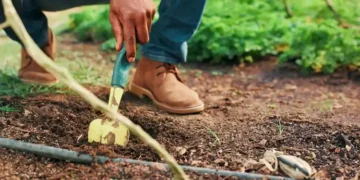
For a smaller bed, a broadfork or a garden fork does the trick, working the soil without flipping it over the way a shovel does.
For lawns, core aeration, the kind that actually pulls little plugs of soil out rather than just poking holes, tends to work a lot better than the spike kind.
Timing matters just as much as the tool here. Working clay while it’s wet is one of the fastest ways to make the whole problem worse.
Wet clay compacts even easier, and it can dry into something close to a solid slab. Wait until it’s just moist enough to crumble in your hand instead.
Step Two: Feed the Soil With Organic Matter
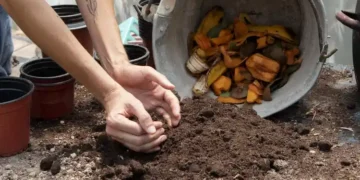
Compost, aged manure, leaf mold, they all do the same basic job in clay. As they break down, they form small clumps, little aggregates of soil particles loosely stuck together, and those clumps leave gaps that water and air can actually move through.
This is honestly the most reliable long-term fix for clay drainage there is. It’s just not instant.
A solid starting point for genuinely rough ground is working two to three inches of finished compost into the top six to eight inches of soil, once a year. Most people start noticing a real difference within a season or two.
Step Three: Gypsum, for a Specific Kind of Clay Problem
Gypsum, or calcium sulfate if you want the technical name, works differently than a typical amendment, so it’s worth understanding on its own.
Instead of adding bulk organic matter, gypsum supplies calcium that gets tiny clay particles to clump together into bigger, sturdier aggregates.
There’s a name for that process, flocculation, but the plain English version is that it makes the little clay plates stop packing so tight.
Where gypsum really shines is sodic clay, soil that’s high in sodium. That shows up a lot near roads that get salted every winter, or on land that’s been irrigated with salty water for years.
If your clay doesn’t have a sodium issue, gypsum still helps some, but compost and organic matter usually do more of the actual work.
This is exactly why the soil test matters. It tells you which situation you’re actually in before you spend money guessing.
The Sand Myth (This One Trips Up Almost Everyone)
Here’s a piece of advice I wish would just go away. It sounds logical on the surface: sand drains well, clay doesn’t, so mix some sand in and problem solved, right?
Wrong, actually. Adding a small amount of sand to clay can make drainage worse, not better.
The reason comes down to ratios.
Sand and clay only work together once sand makes up the large majority of the mix, something like 80 percent or more.
Below that, the sand grains just get swallowed up by the clay, filling in whatever gaps were left rather than opening new ones. What you end up with is denser and harder than what you started with.
Ironically, that’s basically the same principle behind adobe and cob construction, clay, sand, and straw mixed together specifically because it hardens into something solid enough to build a wall out of.
If you’re going to use sand for drainage at all, it needs a serious volume of coarse material and organic matter alongside it, not a sprinkle on top.
When Amendments Aren’t Enough: French Drains and Swales
Sometimes a spot just collects more water than any amendment is ever going to fix, especially low areas where water naturally runs down from higher ground nearby.
In cases like that, redirecting the water usually works better than trying to get the soil to absorb all of it.
A French drain, a gravel-filled trench with a perforated pipe running through it, carries water away to a lower spot where it can actually drain.
A swale, a shallow sloped channel, does something similar above ground, steering runoff toward a rain garden instead of letting it sit and pool.
Both usually need a good amount of coarse gravel, and sometimes washed sand, to move the water through.
Buying that kind of material in bulk almost always beats buying it bag by bag, especially once you’re talking about more than a small bed.
Work With Clay, Not Against It
While you’re improving the soil, it helps to lean into what clay is naturally good at instead of fighting it everywhere at once.
Deep-rooted cover crops like daikon radish punch straight through compacted layers and leave channels behind once they break down, doing some of your aeration work for free.
For permanent beds, plants that already tolerate heavier, wetter soil, a lot of native perennials, certain shrubs, moisture-loving trees, just need less babying than something that wants loose, fast-draining ground.
None of this replaces improving the soil itself. It just means you’re not fighting an uphill battle in every corner of the yard at once.
Mistakes That Undo All That Work
A few habits quietly wreck all the progress above, and I see all of them regularly.
Walking or working on wet clay, even with good intentions, packs it right back down.
Sprinkling in a thin layer of sand as a quick fix, covered above, usually backfires.
Expecting one season of compost to undo years of compaction sets you up to feel like it isn’t working, when really it just needs more time.
And skipping the soil test means picking amendments off a guess instead of what your actual clay needs.
Frequently Asked Questions
1. How long does it actually take to fix drainage in clay soil?
Most people notice a real difference within one growing season, especially once compaction is broken up and organic matter’s been worked in. Soil that’s been compacted for years, construction sites especially, can take two or three seasons of steady work before it behaves like normal garden soil.
2. Can I just add sand to clay to fix drainage?
Not in small amounts, no. Like we covered above, sand only helps once it’s the clear majority of the mix, around 80 percent or higher. Below that, it tends to fill gaps between clay particles instead of creating new ones, which makes things denser, not better draining.
3. Does gypsum work on every type of clay?
It works best on sodic clay, meaning clay with a sodium problem, common near winter-salted roads or land irrigated with salty water for a long stretch. On clay without a sodium issue, gypsum still helps a bit, but organic matter and breaking up compaction usually do more of the real work.
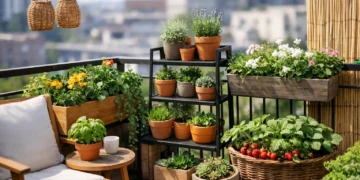
4. Is a raised bed a decent shortcut around clay soil?
Honestly, yes, especially for vegetables or anywhere you want faster results than amending the ground itself. Build it with a proper soil mix and you sidestep the clay drainage problem completely for that spot, while the ground around it can still get better over time.
Improving Clay Soil Takes Time, Not Magic
Clay isn’t a lost cause. In a lot of ways it’s actually more forgiving long term than sandy soil, since it holds onto water and nutrients so much better once drainage stops being a problem.
There’s rarely one single product or one afternoon that fixes it. It’s compaction relief, organic matter added consistently, the right amendment for your specific soil chemistry, and for the worst spots, real drainage infrastructure instead of another bag of something poured on top.
Most people see genuine improvement within a season, and clay that’s been worked steadily for two or three years usually ends up behaving like a completely different soil, one that holds water evenly instead of flooding, and drains without turning to dust.
Whether you’re fixing up a single bed or putting in a full French drain system, having good compost, topsoil, gravel, sand, and the right materials on hand makes the whole job easier. AHC Landscape Supply can help you pick the right materials and get them delivered in bulk.
Sources
- Colorado State University Extension, “Estimating Soil Texture: Sandy, Loamy, or Clayey,” GardenNotes #214, on the sand-to-clay ratio needed before a mix actually behaves like sand rather than clay. cmg.extension.colostate.edu/Gardennotes/214.pdf
- Clemson University Cooperative Extension, Home & Garden Information Center, “Soil Conditioning: Establishing a Successful Gardening Foundation,” on why sand worked into clay can create a concrete-like mixture. hgic.clemson.edu/factsheet/soil-conditioning-establishing-a-successful-gardening-foundation/
- University of Arizona Cooperative Extension, “Using Gypsum and Other Calcium Amendments in Southwestern Soils,” on how gypsum causes clay particles to flocculate and why it matters most in sodic soil. extension.arizona.edu/sites/default/files/2024-08/az1413.pdf
- Colorado State University Extension, “Choosing a Soil Amendment,” on incorporating compost into the top 6 to 8 inches of soil. extension.colostate.edu/docs/pubs/garden/07235.pdf
- University of Maryland Extension, “Forage Radish: A New Multi-Purpose Cover Crop for the Mid-Atlantic,” on daikon and forage radish taproots breaking up compacted soil layers. enst.umd.edu/sites/enst.umd.edu/files/files/documents/Research&Extension/Forage_Radish_Cover_Crop.pdf
- Clemson University Cooperative Extension, Home & Garden Information Center, “Aerating Lawns,” on the difference between core aeration and spike aeration in compacted, clay-heavy lawns. hgic.clemson.edu/factsheet/aerating-lawns/