There’s something irresistibly comforting about a cottage garden. Unlike perfectly clipped hedges and meticulously symmetrical flowerbeds, cottage gardens feel relaxed, romantic, and wonderfully alive.
Flowers tumble over paths, herbs mingle with roses, bees drift between blossoms, and every corner seems to hide something worth discovering.
What I love most about cottage garden style is that it doesn’t demand perfection. In fact, a little imperfection is part of its charm.
Plants are allowed to spill into one another, pathways can curve rather than march in straight lines, and weathered pots or an old wooden bench often look better than something brand new.
The result is a garden that feels welcoming rather than formal—a place where I genuinely want to linger with a cup of coffee, listen to the birds, and forget about everything else for a while.
See more How To Guide Ideas >
If you’re dreaming of creating that same atmosphere, here are some of my favorite cottage garden inspirations for bringing whimsy, softness, and serenity into practically any outdoor space.
1. Begin With a Relaxed Layout
One of the biggest differences between a cottage garden and a formal garden is the layout.
Traditional formal gardens tend to rely on symmetry and clearly defined planting areas. Cottage gardens feel much more spontaneous.
I like to think in terms of journeys rather than straight lines.
Instead of seeing the entire garden the moment you step outside, create little areas that reveal themselves gradually. A curving pathway might disappear behind a flowering shrub. A bench could be tucked beneath an arch. A small seating area might be surrounded by tall flowers.
This sense of discovery makes even a relatively small garden feel more interesting.
Try incorporating:
Curved pathways
Informal flower borders
Hidden seating areas
Arches and gateways
Small garden rooms
Plants overlapping the edges of paths
The trick is to make everything look natural without allowing the garden to become completely chaotic.
2. Pack Your Borders With Flowers
Sparse planting doesn’t really belong in a traditional cottage garden.
Instead, cottage borders are usually overflowing with plants.
Tall flowers stand behind shorter ones, groundcovers creep around their feet, and climbing plants weave their way upwards.
Some classic cottage garden flowers include:
Roses
It would be difficult to imagine a romantic cottage garden without roses.
Shrub roses and climbing roses are particularly beautiful because they create that soft, slightly wild appearance associated with traditional cottage gardens.
Grow climbing roses over:
Arches
Pergolas
Walls
Fences
Doorways
Choose varieties suited to your climate and growing conditions rather than selecting purely by appearance.
Lavender
Lavender is one of my favorite plants for edging paths.
Its silver-green foliage looks attractive even before the flowers appear, and when it blooms, it brings color and fragrance to the garden.
Bees usually appreciate it too.
Foxgloves
Few plants create cottage garden drama quite like foxgloves.
Their towering flower spikes look beautiful emerging from mixed borders, particularly when combined with roses, ferns, hardy geraniums, and other softer plants.
Just remember that foxgloves are toxic if eaten, so take care when gardening around young children and pets.
Delphiniums
Delphiniums add wonderful vertical structure to cottage borders.
Their tall flower spikes can provide a backdrop for shorter plants and are especially striking when several are planted together.
Hollyhocks
Hollyhocks look almost made for cottage gardens.
Try planting them against walls, fences, sheds, or along the back of sunny borders.
Their height helps turn an ordinary boundary into part of the garden display.
Hardy Geraniums
Hardy geraniums are excellent filler plants.
They spread naturally between larger plants and help create the full, abundant appearance that makes cottage gardens so appealing.

3. Don’t Be Afraid to Mix Colors
Modern garden design often encourages limited color palettes.
Cottage gardens give us much more freedom.
Pink roses can sit beside purple lavender, white daisies, blue delphiniums, yellow flowers, and deep red blooms without looking out of place.
You can certainly create a coordinated palette if you prefer.
For a calm cottage garden, I particularly like combinations of:
Soft pink
Mauve
Lavender
White
Pale blue
For something livelier, combine:
Deep pink
Purple
Golden yellow
Red
Bright blue
Repeating a few colors throughout the garden helps tie everything together without making it feel overly planned.
4. Let Plants Spill Onto Pathways
Perfectly crisp edges can sometimes make a cottage garden look too formal.
Instead, allow certain plants to soften those boundaries.
Low-growing flowers can lean over stepping stones while thyme or other creeping plants grow between paving.
This creates the feeling that the pathway has existed for years and the garden has gradually grown around it.
Just make sure the path itself remains safe and comfortable to walk along.
5. Create a Winding Garden Path
Few things create instant cottage garden character as effectively as a winding path.
Straight paths show us exactly where we’re going.
Curved ones make us curious.
Materials that work particularly well include:
Gravel
Brick
Flagstone
Stepping stones
Reclaimed paving
Bark or wood chips for informal areas
Gravel is particularly useful because it creates that wonderfully relaxed country-garden appearance while being relatively straightforward to install.
A pathway becomes even more charming when flowers spill gently over its edges.
6. Add a Flower-Covered Arch
Garden arches immediately introduce height and romance.
Position one at:
The garden entrance
The beginning of a pathway
Between two garden areas
Over a gate
At the entrance to a vegetable garden
Then train climbing plants over it.
Depending on your climate and conditions, possibilities include:
Climbing roses
Clematis
Honeysuckle
Jasmine
Sweet peas
Wisteria
Always check the mature size of vigorous climbers before planting them against lightweight structures.

7. Hide a Bench Among the Flowers
Every cottage garden deserves somewhere to sit.
Instead of placing all the seating directly beside the house, I love the idea of creating a second destination deeper inside the garden.
A wooden or metal bench surrounded by flowers instantly becomes a peaceful retreat.
Place it somewhere with a pleasant view and, if possible, a little privacy.
You could surround it with:
Lavender
Roses
Catmint
Hardy geraniums
Ferns
Hydrangeas
Suddenly, an unused corner becomes somewhere you’ll actually want to spend time.
8. Mix Flowers With Edible Plants
Traditional cottage gardens weren’t purely decorative.
Historically, gardens around homes often needed to be useful as well as beautiful.
That’s why mixing flowers, vegetables, fruit, and herbs feels so natural within this style.
You might grow:
Rosemary beside roses
Chives along a flower border
Strawberries around edging
Kale among ornamental plants
Runner beans over an arch
Fruit trees surrounded by flowers
Herbs are especially easy to integrate.
Thyme, sage, oregano, rosemary, chives, and parsley can all look surprisingly decorative.

9. Create a Charming Herb Corner
A small herb garden is one of the easiest cottage-style features to introduce.
You don’t need a dedicated vegetable garden either.
A collection of terracotta pots filled with herbs can look beautiful beside a back door or along a sunny wall.
Try growing a mixture such as:
Thyme
Rosemary
Mint
Sage
Chives
Parsley
Oregano
Mint is often better grown in containers because it can spread vigorously.
Adding little plant labels or weathered wooden markers gives the area even more character.
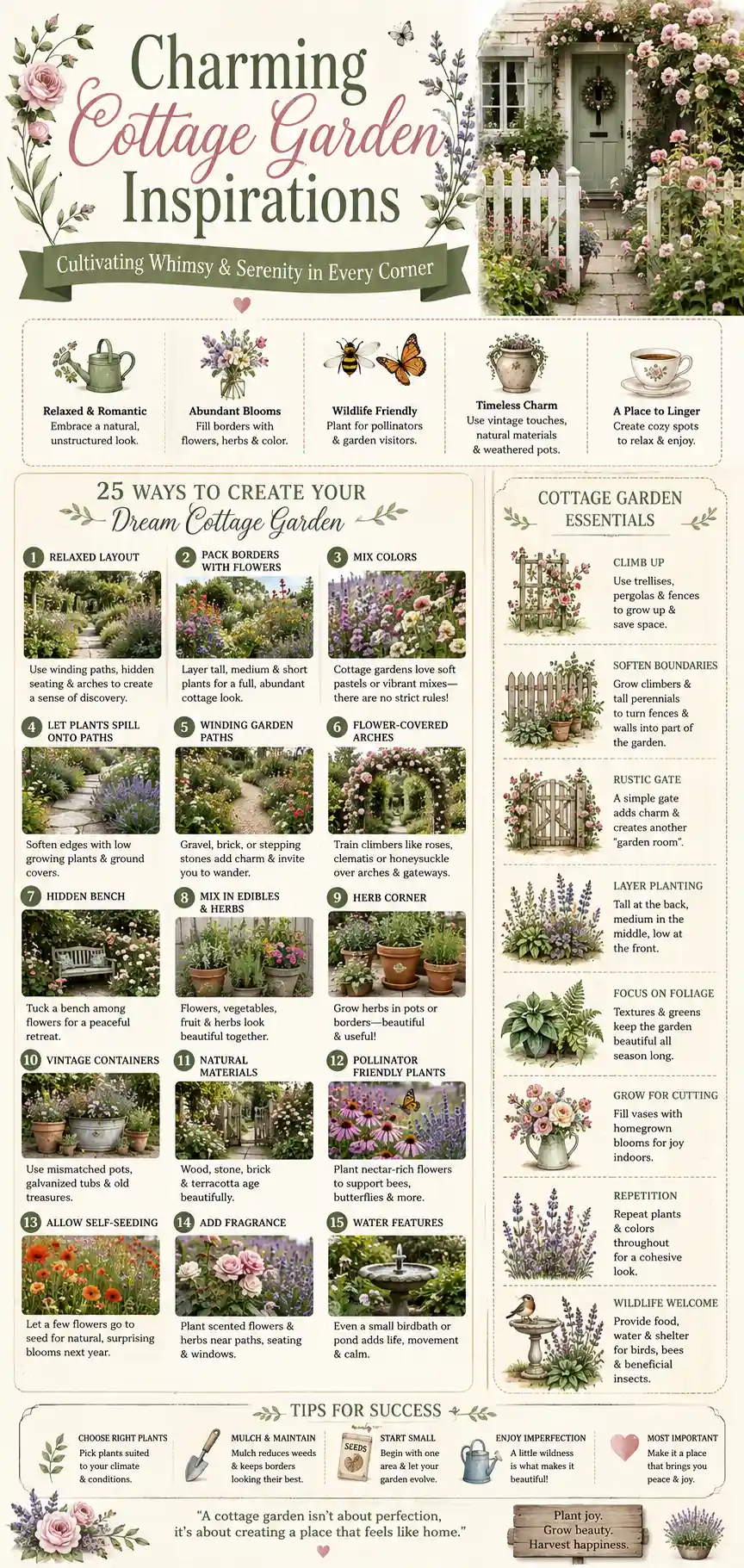
10. Add Vintage and Weathered Containers
Cottage gardens don’t need everything to match.
In fact, mismatched containers often look better.
Terracotta pots are always a favorite of mine because they develop character as they weather.
You can also incorporate suitable reclaimed objects such as:
Galvanized tubs
Wooden planters
Old watering cans used decoratively
Stone troughs
Vintage-style planters
The key is restraint.
A few well-placed vintage pieces create charm. Too many can make the garden look cluttered.
11. Use Natural Materials Wherever Possible
Cottage gardens tend to work beautifully with materials that age gracefully.
Wood, brick, gravel, stone, terracotta, and weathered metal generally blend into planting much more naturally than highly polished surfaces.
Consider using natural materials for:
Paths
Raised beds
Fencing
Planters
Seating
Trellises
Garden edging
They don’t necessarily need to look old when installed. Over time, weathering often makes them look even better.
12. Grow Flowers for Pollinators
A cottage garden becomes much more magical when it’s buzzing with life.
Choosing nectar- and pollen-rich flowers can help support bees, butterflies, hoverflies, and other beneficial insects.
Depending on your region and climate, consider plants such as:
Lavender
Catmint
Coneflowers
Asters
Salvia
Yarrow
Foxgloves
Single-flowered roses
Verbena
Native wildflowers
Try to include plants that flower at different points throughout the growing season.
That provides food for pollinators for longer while giving your garden changing displays of color.
13. Allow Some Flowers to Self-Seed
One of the secrets behind the wonderfully spontaneous cottage garden look is self-seeding.
Instead of removing every flower immediately after blooming, allow selected plants to produce seed.
Plants may then appear naturally in unexpected places the following year.
Depending on your growing conditions, self-seeding possibilities might include:
Foxgloves
Nigella
Calendula
Poppies
Forget-me-nots
Aquilegia
You’ll still need to remove seedlings growing somewhere inconvenient, but the occasional surprise plant can make a garden feel wonderfully natural.
14. Add Fragrance Near Seating Areas
Cottage gardens should appeal to more than just our eyes.
Fragrance can completely change the atmosphere of a space.
Position scented plants close to areas where you’ll actually notice them.
Good locations include:
Beside paths
Around patios
Near benches
Close to windows
Around entrances
Roses, lavender, honeysuckle, jasmine, sweet peas, herbs, and other fragrant plants can all contribute.
Imagine sitting outside on a warm evening with the scent of honeysuckle or roses drifting across the garden. That’s exactly the kind of sensory experience I want from a cottage garden.
15. Introduce a Small Water Feature
Water brings a lovely sense of calm.
And you don’t necessarily need space for a large pond.
Even a small water feature can create movement and reflections while potentially providing drinking and bathing opportunities for wildlife.
Consider:
A small wildlife pond
A container pond
A simple birdbath
A stone water bowl
A small fountain
For a cottage garden, I usually prefer simple designs that look as though they’ve naturally become part of the landscape.
16. Embrace Vertical Gardening
When garden space is limited, look upwards.
Walls, fences, arches, sheds, and pergolas provide valuable growing space.
Climbers also soften hard structures and make the garden feel established.
Use trellises or supports for plants such as:
Clematis
Roses
Honeysuckle
Sweet peas
Jasmine
Climbing hydrangea
Even vegetables such as beans can contribute to the cottage aesthetic when grown on attractive supports.
17. Soften Fences and Walls
Bare fences can dominate small gardens.
Rather than hiding them entirely, make them part of the planting scheme.
Grow climbers against them and position shrubs or tall perennials in front.
You can also hang a few planters or install simple wooden trellises.
Within a few growing seasons, a plain boundary can become a beautiful backdrop filled with greenery and flowers.
18. Add a Rustic Gate
There’s something delightfully storybook-like about a garden gate surrounded by flowers.
Even if you don’t genuinely need a gate for security, one can help divide different sections of the garden.
A simple wooden gate looks particularly charming beneath an arch covered in roses or clematis.
It creates a sense that another little garden world is waiting on the other side.
19. Create Layered Planting
Successful cottage borders may look spontaneous, but they usually benefit from thoughtful layering.
Think of the border in three broad levels.
Back of the Border
Use taller plants such as:
Delphiniums
Hollyhocks
Tall grasses
Shrub roses
Foxgloves
Middle of the Border
Try:
Salvias
Peonies
Coneflowers
Catmint
Medium-sized shrubs
Front of the Border
Use lower-growing plants including:
Hardy geraniums
Thyme
Dianthus
Alyssum
Small ornamental grasses
This creates depth while ensuring that shorter plants don’t disappear behind taller ones.
20. Don’t Forget Foliage
Flowers get most of the attention, but foliage is what helps a cottage garden look attractive between periods of bloom.
Mix different leaf shapes and textures.
You might combine:
Fine ornamental grasses
Ferns
Broad hosta leaves
Silver foliage
Evergreen shrubs
Small-leaved herbs
Foliage provides structure and stops the garden from becoming dependent entirely on flowers.
21. Grow Flowers for Cutting
One lovely benefit of an abundant cottage garden is having flowers available for the house.
You don’t need a dedicated cutting garden.
Simply grow enough flowers that removing a few stems won’t spoil the display.
Depending on your growing conditions, excellent cutting flowers include:
Cosmos
Dahlias
Sweet peas
Roses
Zinnias
Snapdragons
Sunflowers
A relaxed bunch of flowers gathered from the garden somehow feels even more special than a perfectly arranged bouquet.
22. Use Repetition to Prevent Chaos
There’s a fine line between charming abundance and visual confusion.
One of the easiest ways to keep cottage planting cohesive is repetition.
Repeat certain plants or colors throughout the garden.
For example, you might use the same lavender beside several sections of pathway or repeat pink roses in different borders.
Your garden can still feel informal, but repetition quietly ties everything together.
23. Add Small Details That Invite Exploration
Some of the best cottage garden moments don’t involve huge flower displays.
They’re little surprises.
You might include:
A birdbath tucked among flowers
A small decorative sign
An old pot overflowing with herbs
A miniature seating nook
A simple sundial
A decorative trellis
A few stepping stones leading somewhere unexpected
I prefer keeping these touches subtle.
The garden should feel like you’re discovering them rather than looking at a collection of ornaments.
24. Make Room for Wildlife
Cottage gardens naturally lend themselves to wildlife-friendly gardening.
Dense planting creates shelter while flowers provide food for insects.
You can make the garden even more inviting by including:
Bird baths
Bird boxes
Native plants
Berry-producing shrubs
Small ponds
Dense hedging
Nectar-rich flowers
Avoiding unnecessary pesticide use can also help protect beneficial insects and other garden wildlife.
The more life that visits the garden, the more magical it tends to feel.
25. Leave a Little Imperfection
This may be my favorite cottage garden rule.
Don’t try to control everything.
A flower leaning into a pathway isn’t necessarily a problem.
Moss growing on old stone can be beautiful.
A weathered terracotta pot doesn’t need replacing simply because it’s no longer perfect.
Cottage gardening gives us permission to appreciate age, change, and unpredictability.
Of course, there’s still maintenance involved. Weeds need controlling, plants sometimes need dividing, climbers require support, and paths need to remain usable.
But visually, the garden doesn’t have to appear immaculate.
That’s part of its charm.
Creating Cottage Charm in a Small Garden
You don’t need a sprawling country garden to embrace cottage style.
A small yard, patio, or even balcony can borrow many of the same principles.
Focus on:
Generous planting
Climbing flowers
Terracotta pots
Herbs
Fragrant plants
Vertical supports
A small seating area
In tiny spaces, I’d rather have a handful of large containers overflowing with plants than dozens of little pots scattered everywhere.
Grouping plants together creates that lush cottage feeling much more effectively.
Creating Cottage Charm on a Budget
Cottage gardens can also be surprisingly economical.
They don’t require expensive landscaping or pristine materials.
Save money by:
Growing plants from seed
Dividing existing perennials
Swapping plants with friends
Allowing suitable plants to self-seed
Buying young plants instead of mature specimens
Reusing existing pots
Using simple gravel pathways
Choosing long-lived perennials
Start with one border rather than trying to transform the whole garden at once.
Cottage gardens actually improve with age, so there’s no reason everything has to be finished immediately.
How to Keep a Cottage Garden Manageable
The biggest misconception about cottage gardening is that the relaxed appearance means there’s no maintenance.
There certainly is.
The difference is that the garden doesn’t need to look perfectly manicured.
To make things easier, I recommend:
Choose plants suitable for your conditions. Trying to force sun-loving plants into deep shade—or moisture-loving plants into dry soil—creates unnecessary work.
Plant densely but sensibly. Filling borders reduces empty soil where weeds can establish, but plants still need enough room to reach their mature size.
Use mulch. A layer of suitable organic mulch can help conserve moisture, improve soil conditions, and reduce weed growth.
Include reliable perennials. Annual flowers are wonderful, but filling the entire garden with them every year can become expensive and time-consuming.
Deadhead selectively. Remove spent blooms when you want repeat flowering, but leave some seed heads for wildlife or self-seeding.
Accept seasonal change. Cottage gardens aren’t supposed to look exactly the same twelve months of the year.
My Ideal Cottage Garden Combination
If I were creating a cottage garden from scratch, I’d begin with a simple winding gravel path.
I’d plant lavender along parts of the edge and allow hardy geraniums to soften the remaining sections.
Along the back of the borders, I’d grow roses, foxgloves, and a few taller shrubs. Catmint, salvias, herbs, and other perennials would fill the middle.
A rose-covered arch would lead to a small wooden bench hidden towards the back.
Nearby, I’d add a birdbath and perhaps a small container pond.
I’d leave a sunny corner for herbs and edible plants and allow a few carefully chosen flowers to self-seed wherever they please.
Most importantly, I wouldn’t try to make everything perfect.
I’d want it to feel like a garden that has slowly evolved rather than one that appeared overnight.
Final Thoughts
Creating a charming cottage garden isn’t really about following strict rules. It’s about building an outdoor space that feels abundant, personal, and inviting.
Fill borders generously. Mix flowers with herbs. Let roses climb over arches. Allow plants to soften pathways. Add somewhere comfortable to sit and give yourself a reason to wander through the garden rather than simply looking at it from the house.
And don’t worry if things become slightly unruly.
In a cottage garden, a little wildness is often exactly what makes everything beautiful.
Over time, plants will spread, surfaces will weather, seedlings will appear in unexpected places, and the garden will develop its own personality.
That’s when the real magic begins.