
I’m a big believer that gardening doesn’t have to involve constantly buying new things.
In fact, some of the most useful garden accessories are probably already sitting in your kitchen cupboards, recycling bin, garage, or shed.
Reusing household items in the garden can save money, reduce waste, and sometimes give you a better solution than something you would have bought specifically for gardening.
From turning cardboard into weed suppressant to transforming old colanders into hanging baskets, there are plenty of clever ways to give everyday household objects a second life.
Here are 20 of my favorite ideas.
1. Turn Toilet Paper Rolls Into Seed Pots
Empty toilet paper rolls make surprisingly useful biodegradable seed pots.
Simply cut a few short slits around one end, fold the sections inward to create a base, and fill the tube with potting mix.
They work especially well for plants that dislike having their roots disturbed, such as:
Peas
Beans
Sweet peas
Sunflowers
Corn
When it is time to plant your seedling outside, you can usually plant the cardboard tube directly into the soil.
I like to tear or loosen the bottom first so the roots can escape easily.
Make sure the cardboard is well buried, as exposed cardboard can wick moisture away from the soil.
2. Use Egg Cartons for Starting Seeds
Cardboard egg cartons are another useful seed-starting option.
Each individual compartment acts like a miniature planting cell.
Add seed-starting mix, sow one or two seeds in each section, and keep the compost lightly moist.
Once your seedlings are large enough, cut the compartments apart before planting.
Cardboard cartons will gradually decompose, although I prefer to tear away some of the cardboard before planting so it doesn’t restrict young roots.
Avoid plastic or foam egg cartons unless you plan to reuse them repeatedly rather than plant them into the soil.
3. Use Cardboard Boxes to Suppress Weeds
Cardboard is one of my favorite materials for creating new planting areas.
If you have an overgrown patch of lawn or weeds that you want to turn into a bed, lay plain cardboard directly over the area.
Overlap the pieces so weeds cannot easily grow through the gaps.
Then cover the cardboard with materials such as:
Compost
Wood chips
Leaf mold
Mulch
Well-rotted manure
The cardboard blocks light and helps suppress existing vegetation underneath.
Over time, it breaks down and becomes part of the soil.
Remove packing tape, plastic labels, staples, and heavily glossy coatings before using cardboard in the garden.
4. Turn Old Colanders Into Hanging Baskets
If you have an old metal colander that has seen better days, don’t throw it away.
The drainage holes make it ideal for growing plants.
You can use an old colander for:
Trailing flowers
Herbs
Strawberries
Succulents
Small ornamental plants
Line the inside with coconut coir, moss, or another suitable basket liner before adding potting mix.
Colanders with sturdy handles can sometimes be suspended using chain or strong garden wire.
Just remember that filled containers can become very heavy, particularly after watering.
5. Turn Plastic Bottles Into Slow Waterers
Plastic drinks bottles can be turned into simple plant-watering devices.
Make several tiny holes in the bottle cap, fill the bottle with water, replace the cap, and push the bottle upside down into the soil beside the plant.
Water will slowly seep into the surrounding soil.
These can be particularly helpful around thirsty crops such as:
Tomatoes
Cucumbers
Squash
Zucchini
Alternatively, remove the bottom of the bottle and bury the neck beside the plant.
You can then pour water directly into the bottle so it reaches the root zone rather than running across the surface.
6. Use Yogurt Pots as Seedling Containers
Large yogurt pots make excellent reusable plant pots.
Wash them thoroughly and punch several drainage holes into the bottom.
They are particularly useful when seedlings have outgrown smaller seed trays but aren’t ready to go outside.
I also like clear yogurt pots because you can sometimes see root development through the sides.
However, roots generally prefer darkness, so place a clear pot inside an opaque container if you plan to keep the plant in it for long.
7. Turn Old Spoons Into Plant Labels
Old metal or wooden spoons can become quirky garden labels.
Simply write or paint the plant name onto the spoon and push the handle into the soil.
Wooden spoons are particularly easy to decorate using permanent garden markers or exterior paint.
This is a fun project if you’re gardening with children.
Old wooden craft sticks also work well.
8. Use Wine Corks as Plant Markers
If you save wine corks, they can easily be turned into plant labels.
Write the plant name on the cork using permanent marker and push the cork onto the end of a bamboo skewer or wooden stick.
You instantly have a reusable label.
These work particularly well in herb gardens and vegetable beds where you might want to label several varieties.
9. Turn Old Buckets Into Planters
Buckets make some of the most useful recycled garden containers.
Before planting anything in one, drill several drainage holes into the bottom.
You can grow plenty of crops in buckets, including:
Tomatoes
Peppers
Potatoes
Salad leaves
Herbs
Strawberries
Always check what the bucket previously contained.
I would avoid using containers that have stored paint, industrial chemicals, pesticides, oils, or anything else potentially harmful, particularly when growing edible plants.
Food-grade buckets are a much safer choice.
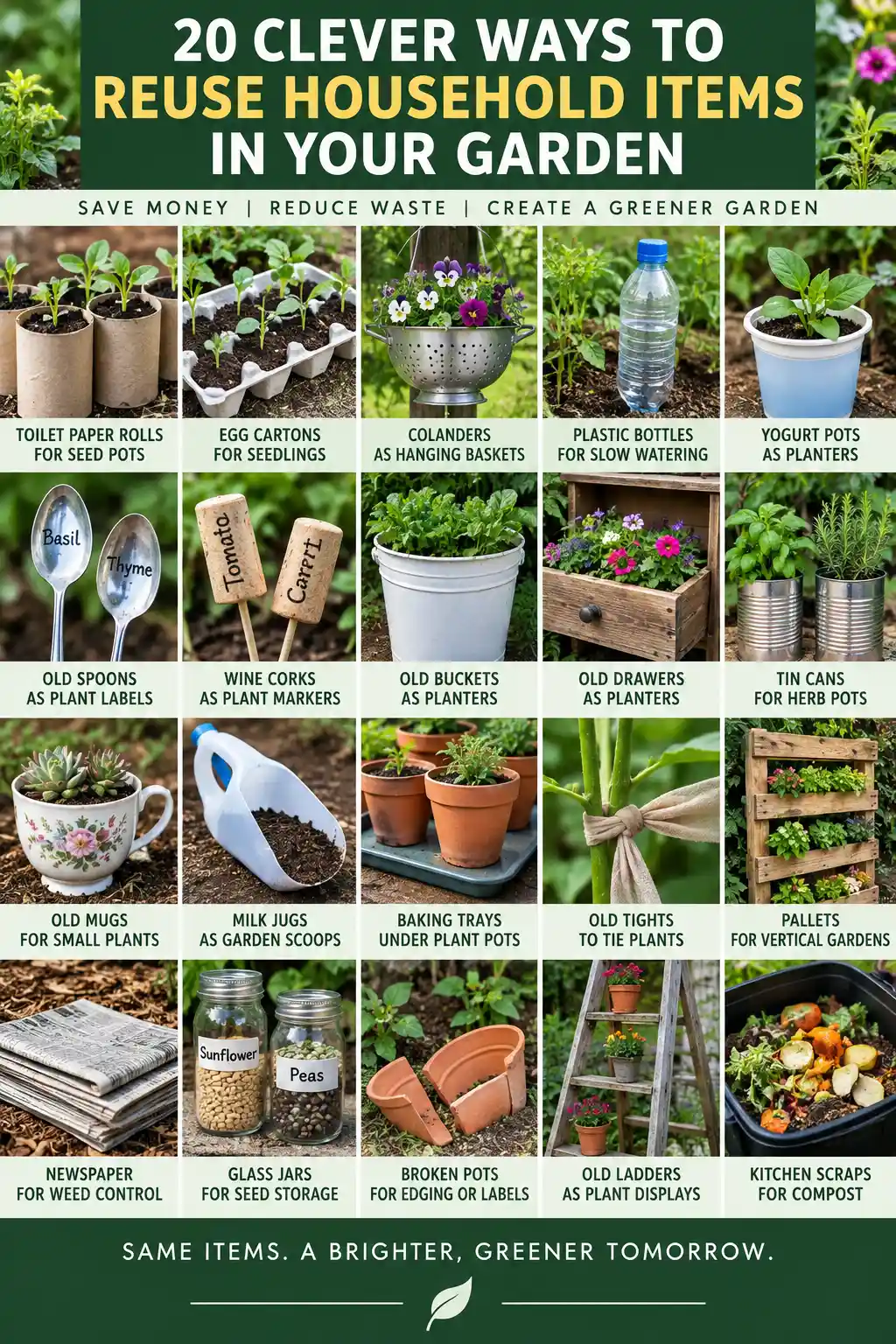
10. Use Old Drawers as Planters
An unwanted chest of drawers can provide several ready-made garden planters.
Remove the drawers, add drainage holes if necessary, and use them as rustic containers.
Alternatively, leave the drawers partly open and plant directly into them to create a stepped display.
Trailing flowers can look fantastic spilling over the edges.
Because indoor furniture is rarely designed to survive outdoors, untreated wooden drawers will gradually deteriorate.
I tend to see this as a temporary upcycling project rather than something that will last forever.
11. Turn Tin Cans Into Herb Pots
Food cans can make attractive small planters.
Remove the label, wash the can thoroughly, and carefully create several drainage holes in the bottom.
They are useful for growing small herbs such as:
Parsley
Chives
Cilantro
Thyme
You can paint the outside or leave the metal exposed for a more industrial look.
Be extremely careful around cut metal edges.
If the rim is sharp, don’t use the container somewhere children or pets could easily reach it.
12. Use Old Mugs and Teacups for Small Plants
Cracked or chipped mugs don’t always have to go in the trash.
They can make charming containers for small plants.
Succulents are particularly suited to teacups because they don’t need a huge amount of soil.
Drainage is important, though.
If you cannot safely drill a hole into the cup, use it as an outer decorative container with a smaller plastic nursery pot inside.
That way, you can remove the plant for watering and allow excess water to drain away.
13. Turn Plastic Milk Jugs Into Scoops
Large plastic milk jugs can easily be converted into handy garden scoops.
Leave the handle intact and cut diagonally across the lower section of the container.
You now have a lightweight scoop that can be used for:
Potting soil
Compost
Birdseed
Fertilizer
Gravel
Smooth any rough plastic edges before using it.
This is one of those simple ideas that can save you from buying yet another garden tool.
14. Use Old Baking Trays Under Plant Pots
Old baking trays can make useful drip trays beneath groups of pots.
I find these particularly helpful when watering seedlings or houseplants.
Instead of individual saucers under every pot, several small containers can sit on one large tray.
Make sure you empty excess standing water rather than leaving pots permanently sitting in it.
Constantly waterlogged compost can lead to root problems.
15. Use Old Tights to Tie Plants
Old tights and stockings make surprisingly good plant ties.
The soft, stretchy fabric supports stems without cutting into them as easily as thin string or wire.
Cut the material into strips and use it to support:
Tomatoes
Climbing beans
Roses
Clematis
Young trees
Tie loosely so there is room for the stem to expand.
This trick has been used by gardeners for generations and remains one of the simplest ways to reuse clothing in the garden.
16. Turn Wooden Pallets Into Vertical Gardens
Wooden pallets can be turned into vertical planters, shelving, compost bays, tool storage, or simple garden furniture.
One popular idea is to stand a pallet upright and attach planting pockets or containers between the slats.
This can create a useful vertical herb or strawberry garden.
However, don’t use just any pallet.
Look for markings showing that the pallet was heat treated rather than chemically fumigated, and avoid pallets with unknown contamination, spills, or strong odors.
If you’re uncertain about its history, don’t use it for growing food.
17. Use Newspaper in Compost or Around Plants
Old newspaper can be useful around the garden, particularly when shredded and added to the compost pile.
Paper provides a carbon-rich “brown” material that can balance nitrogen-rich materials such as grass clippings and kitchen scraps.
You can also lay several sheets of newspaper underneath mulch to temporarily suppress weeds.
Use ordinary newspaper rather than heavily laminated or plastic-coated paper.
Once wet and covered with mulch, newspaper usually breaks down relatively quickly.
18. Turn Glass Jars Into Seed Storage Containers
Empty glass jars are excellent for storing leftover seeds.
Clean the jars thoroughly and make sure they are completely dry before adding seeds.
Label each jar with:
Plant name
Variety
Year collected or purchased
Keep seeds somewhere cool, dry, and dark.
A cupboard in a cool room is usually better than a bright windowsill.
For extra moisture protection, you can add a small silica gel packet saved from suitable packaging, provided it remains sealed and does not contact food or children.
19. Use Broken Terracotta Pots Around the Garden
A broken terracotta pot doesn’t necessarily need to be thrown away.
Larger pieces can be used as:
Plant labels
Decorative mulch
Miniature garden edging
Toad shelters
Pot feet
You may also see advice recommending broken pottery in the bottom of plant pots to improve drainage.
However, adding a thick layer of crocks isn’t generally necessary.
A container with proper drainage holes and a suitable potting mix is far more important.
I prefer to use broken pot pieces for decorative purposes instead.
20. Turn Old Ladders Into Plant Displays
An old wooden ladder can make a fantastic vertical plant stand.
Lean it securely against a wall or use a freestanding step ladder.
Place pots on the steps at different heights to create an easy layered display.
This works particularly well with:
Herbs
Trailing flowers
Succulents
Strawberries
Small houseplants during summer
Make sure the ladder is stable before loading it with pots.
Heavy containers should sit toward the bottom to reduce the risk of tipping.
Bonus Idea: Save Kitchen Scraps for Compost
Not every household item needs to become a planter.
Some of the most useful things you can reuse are kitchen scraps.
Suitable compost ingredients include items such as:
Vegetable peelings
Fruit scraps
Coffee grounds
Tea leaves
Crushed eggshells
Combine these nitrogen-rich materials with plenty of carbon-rich ingredients such as dry leaves, shredded cardboard, and paper.
Given enough time, those scraps can become valuable compost for your garden.
Household Items You Shouldn’t Reuse in the Garden
Upcycling is useful, but not everything belongs in your garden.
I would be particularly cautious about reusing:
Containers That Held Chemicals
Avoid containers that previously held pesticides, solvents, paint, automotive fluids, or other potentially hazardous substances.
This is especially important if you intend to grow vegetables, fruit, or herbs.
Unknown Treated Timber
Some old timber may have been treated with preservatives that you don’t want close to edible plants.
Unless you know what treatment was used, I wouldn’t use mystery wood to construct vegetable beds.
Containers Without Drainage
A beautiful old container isn’t very useful if your plant ends up sitting in water.
Either create proper drainage holes or use the item as a decorative outer pot.
Sharp Metal Objects
Tin cans, broken tools, and other metal objects can develop extremely sharp edges.
Smooth, cover, or safely dispose of anything that could cause injury.
Materials That Quickly Fragment
Some plastics become brittle after prolonged exposure to sunlight.
If plastic begins cracking or breaking into small pieces, it is time to retire it rather than allowing fragments to spread through the garden.
Think Before You Throw Something Away
One of the nicest things about reusing household items in the garden is that you gradually start looking at everyday objects differently.
An old bucket becomes a tomato planter.
A toilet paper roll becomes a seed pot.
An unwanted ladder becomes a plant stand.
And that pile of cardboard from your latest delivery suddenly becomes useful weed control.
You don’t need to turn your garden into a collection of junk, either.
The trick is to reuse things when they genuinely solve a gardening problem.
If something makes sowing, watering, storing, growing, composting, or organizing easier, then giving it a second life makes perfect sense.
You’ll save a little money, reduce waste, and might even end up with a garden that feels far more individual than one filled entirely with things bought from a garden center.
And before you put something in the recycling bin, it is always worth asking yourself one question:
Could I use this in the garden first?
Useful Links
Garden Gate – Best Budget Garden Tips From Our Readers
Includes practical ideas for repurposing mulch bags, old trash cans, glass bottles and other everyday items in the garden.
https://www.gardengatemagazine.com/articles/garden-design/design-tips-inspiration/budget-garden-tips/
HGTV – 35+ Upcycled Container Gardens and Yard Art Made on the Cheap
Lots of inspiration for turning colanders, lunchboxes, wheelbarrows and other unwanted household items into planters and garden features.
https://www.hgtv.com/gardening/garden-design/upcycled-and-whimsical-container-gardens-and-planters-pictures
Premeditated Leftovers – How to Make a Mini Greenhouse
Shows how old yogurt cups, salad containers and milk jugs can be reused for seed starting and other gardening jobs.
https://premeditatedleftovers.com/diy-mini-greenhouse/