Rainwater harvesting sounds like one of those gardening ideas that is obviously sensible: rain falls on your roof, you collect it, and instead of turning on the tap every time your tomatoes look thirsty, you use the water you already have.
But when I first looked into rainwater harvesting, the question I really wanted answered was much simpler:
How much water can you realistically collect, and does it actually save enough money to be worthwhile?
The answer depends on the size of your roof, how much rain you get, how much water your garden uses, and how much storage you have. But even a fairly modest setup can collect a surprisingly large amount of water over the course of a year.
See more Sustainable Gardening Ideas >
Here is how rainwater harvesting works, how to calculate what you could collect, and what sort of savings you can realistically expect.
View Rainwater Harvesting Kits on Amazon.com >
What Is Rainwater Harvesting?
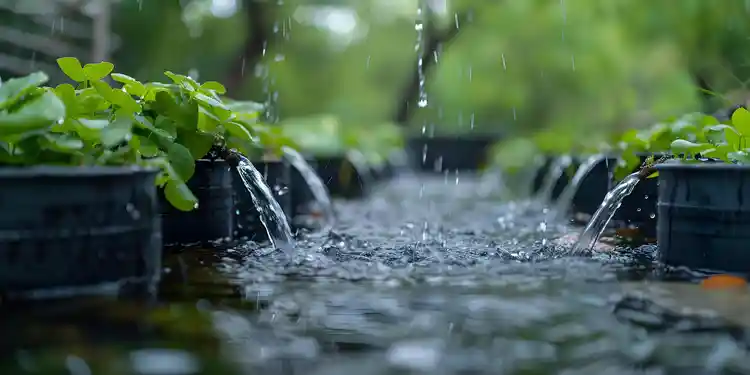
Rainwater harvesting simply means collecting and storing rainwater so that you can use it later.
For most home gardeners, that means directing water from a roof through gutters and downpipes into a container such as:
A rain barrel
A water butt
Several connected barrels
A larger above-ground storage tank
An underground rainwater tank
The collected water can then be used for jobs such as watering flower beds, vegetable gardens, containers and lawns.
More sophisticated systems can sometimes supply water for toilets or washing machines, but for beginners I think garden irrigation is by far the easiest place to start.
You don’t need pumps, underground tanks or expensive equipment.
A barrel connected to a downspout may be enough.
See also: The Impact of Garden Water Conservation Techniques >
How Much Rainwater Can You Actually Collect?
This is where things get interesting.
A roof collects much more water than most people realise.
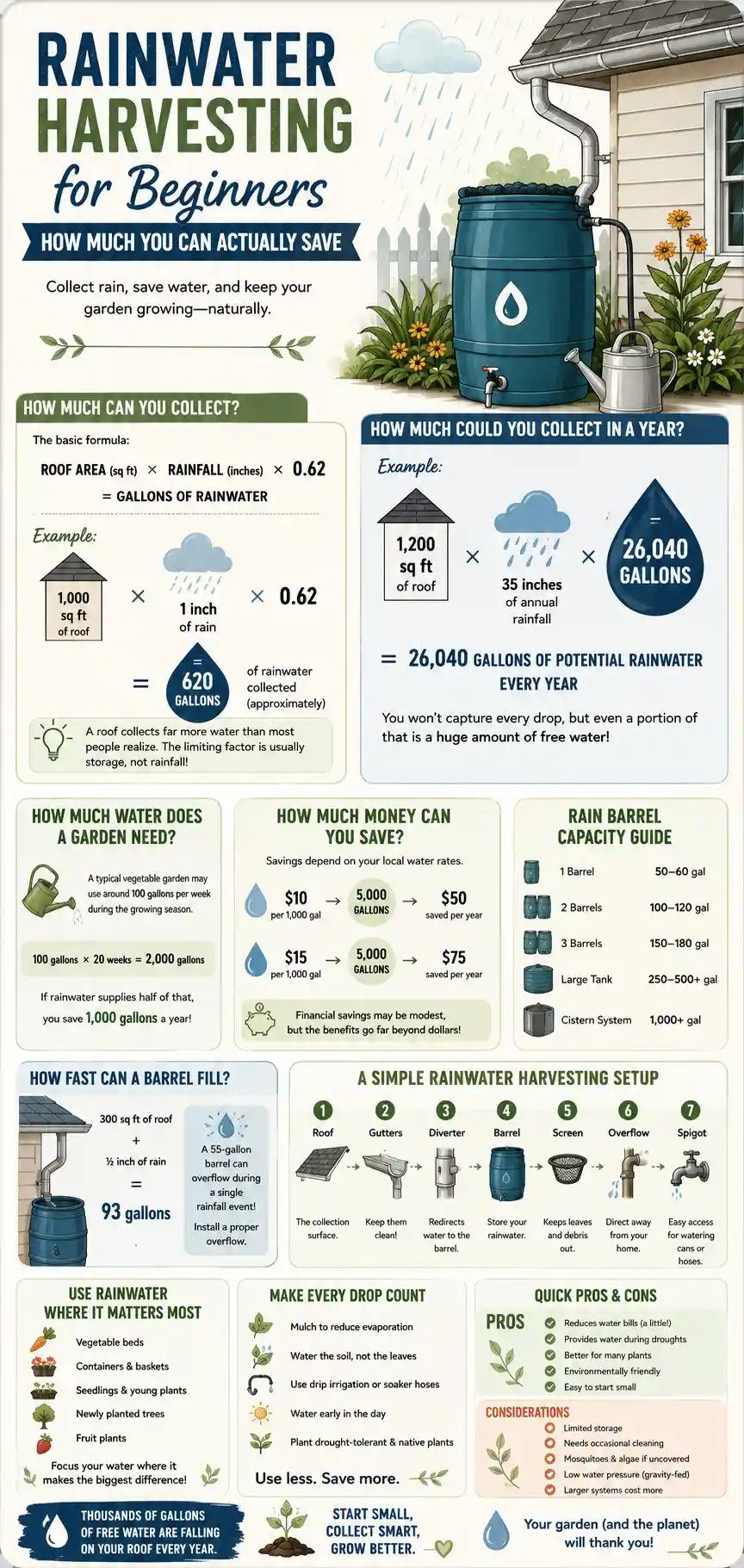
The basic calculation is:
Roof area × rainfall = potential rainwater collection
If you’re working in US measurements, a useful rule of thumb is:
1 inch of rain falling on 1 square foot of roof produces approximately 0.62 gallons of water.
So the calculation becomes:
Roof area in square feet × rainfall in inches × 0.62 = gallons of rainwater
You then allow a little for losses caused by splashing, overflowing, gutter inefficiency and the first rainfall washing debris from the roof.
Example: A Small Roof
Imagine you have 500 square feet of roof feeding into your rain barrel.
You receive 1 inch of rain.
500 × 1 × 0.62 = 310 gallons
That’s potentially more than 300 gallons from just one inch of rainfall.
Obviously, a standard 50-gallon rain barrel wouldn’t be able to hold all of that.
And that leads us to one of the biggest lessons about rainwater harvesting:
The limiting factor usually isn’t rainfall. It’s storage.
How Much Could You Collect in a Year?
Let’s take a slightly larger example.
Suppose your home has 1,200 square feet of roof area available for rainwater collection and your area receives 35 inches of rainfall annually.
1,200 × 35 × 0.62 = 26,040 gallons
In theory, that’s more than 26,000 gallons of rainwater falling on that section of roof every year.
You probably won’t capture all of it.
Some rainfall may be too light to collect efficiently, some water will be lost from the system, and your barrels will frequently overflow when they’re already full.
Even so, it shows just how much free water passes through our gutters.
Rainfall Isn’t the Whole Story
Looking at yearly rainfall figures can actually give you a slightly misleading idea of what you can harvest.
Imagine getting four inches of rain during one storm.
A 1,000-square-foot roof could theoretically receive around:
1,000 × 4 × 0.62 = 2,480 gallons
But if you only have one 55-gallon barrel, you’ll store around 55 gallons.
The rest simply flows through the overflow.
That means increasing storage capacity often makes a much bigger difference than increasing the size of the collection area.
How Much Water Does a Garden Actually Need?
This varies enormously.
A few containers on a patio may only require a small amount of water.
A productive vegetable garden in hot summer weather can use hundreds of gallons.
Things that affect your water consumption include:
Garden size
Climate
Soil type
Plant choice
Temperature
Wind
Mulching
Irrigation method
Amount of shade
How established your plants are
Lawns can be particularly thirsty, while established drought-tolerant borders may require surprisingly little additional watering.
Vegetable gardens generally need more consistent moisture, particularly crops such as tomatoes, cucumbers, squash and leafy greens.
A Simple Example
Let’s say you normally use around 100 gallons of water each week on your garden during the main growing season.
Over 20 weeks, that’s:
100 × 20 = 2,000 gallons
If your rainwater system supplied half of that water, you would reduce your municipal water use by roughly:
1,000 gallons a year.
A larger storage system could potentially cover considerably more.
How Much Money Can Rainwater Harvesting Save?
This is where expectations need to be realistic.
Water itself is relatively inexpensive in many parts of the US.
So collecting 1,000 gallons of rainwater doesn’t necessarily translate into hundreds of dollars of savings.
Your actual saving depends on local water and sewer charges.
As a rough illustration, imagine your combined water costs worked out at around $10 per 1,000 gallons.
Saving 5,000 gallons would therefore save around:
$50 per year.
If water costs $15 per 1,000 gallons, the same amount would save:
$75 per year.
That isn’t going to transform your household finances.
But financial savings aren’t the only benefit.
Rainwater Harvesting Makes More Sense During Drought
The value of stored water becomes much more obvious when rainfall becomes unpredictable.
During periods of drought or water restrictions, your stored rainwater may allow you to keep:
Vegetable plants productive
Newly planted trees alive
Containers watered
Seedlings growing
Fruit plants healthy
Rather than thinking only about the price per gallon, I prefer to think of rainwater harvesting as providing a small reserve of water when the garden needs it most.
What Size Rain Barrel Should You Buy?
The familiar 50- to 60-gallon barrel is a perfectly good starting point.
But don’t be surprised by how quickly it fills.
A 55-gallon rain barrel receiving water from a reasonable area of roof may fill during a fairly ordinary rainstorm.
If you have the space, linking two or three barrels together can make the system much more useful.
For example:
| Storage Setup | Approximate Capacity |
|---|---|
| One barrel | 50–60 gallons |
| Two connected barrels | 100–120 gallons |
| Three connected barrels | 150–180 gallons |
| Large tank | 250–500+ gallons |
| Cistern system | 1,000+ gallons |
If your goal is simply watering a few containers, one barrel may be plenty.
If you’re hoping to irrigate a vegetable garden, I would consider at least 100 to 200 gallons of storage if space allows.
How Quickly Will a 55-Gallon Rain Barrel Fill?
Potentially very quickly.
Let’s say 300 square feet of roof drains into the barrel.
With only half an inch of rain:
300 × 0.5 × 0.62 = 93 gallons
Your 55-gallon barrel could theoretically overflow before that rainfall event has finished.
That is why installing a proper overflow is essential.
You don’t want excess water accumulating around your home’s foundation.
A Beginner Rainwater Harvesting Setup
You really don’t need anything complicated.
A straightforward system consists of:
1. Your Roof
The roof provides the collection surface.
2. Gutters
Gutters collect the water running from your roof.
Keep them reasonably clear of leaves and debris.
3. Downspout Diverter
A diverter redirects some of the water from your downspout into your barrel.
Some designs automatically allow excess water to continue through the downspout once the barrel is full.
4. Rain Barrel
Choose a purpose-built rain barrel or a suitable food-grade container designed for water storage.
5. Screen or Filter
The water entering the barrel should pass through a screen.
This helps keep out leaves, insects and other debris.
6. Overflow
Every rain barrel needs somewhere for excess water to go.
Ideally, overflow water should be directed safely away from your house.
7. Tap or Hose Connection
A tap near the bottom makes it easy to fill watering cans or attach a hose.
Gravity provides the pressure, although it won’t usually match household mains pressure.
Should You Raise Your Rain Barrel?
Yes, if it can be done safely.
Placing the barrel on a strong, stable base increases water pressure slightly and makes it easier to fit a watering can underneath the tap.
But remember how heavy water is.
A US gallon of water weighs roughly 8.3 pounds.
A full 55-gallon barrel therefore contains more than 450 pounds of water before you even include the weight of the container.
The stand needs to be extremely stable and placed on firm, level ground.
Is Rainwater Better for Plants?
Rainwater can be very useful for gardens because it doesn’t contain the same treatment chemicals and mineral concentrations that may be present in municipal tap water.
This can be particularly helpful for plants that dislike hard or alkaline water.
More importantly, using collected rainwater means you’re not using drinking-quality municipal water to irrigate ornamental plants and vegetables.
That always seems like a sensible swap to me.
Where Should You Use Rainwater First?
If your supply is limited, don’t try to water everything.
Prioritize plants that genuinely need it.
I would normally use stored rainwater for:
Seedlings and young plants
Vegetable beds
Containers and hanging baskets
Newly planted trees and shrubs
Fruit plants
Valuable or moisture-sensitive plants
Established ornamental shrubs and mature lawns would be much further down my list.
Combine Rainwater Harvesting With Mulching
Collecting water is only half the equation.
The other half is preventing the water already in your soil from disappearing.
A layer of organic mulch around plants helps reduce evaporation while also suppressing weeds.
Materials can include:
Compost
Shredded leaves
Wood chips
Bark
Straw
Grass clippings used carefully
The combination of rainwater harvesting and mulching can dramatically reduce how often you need to irrigate.
Water the Soil, Not the Leaves
You can also stretch your collected water further by changing how you irrigate.
Water slowly around the base of plants rather than spraying large areas.
This gets moisture closer to the roots and reduces evaporation.
Drip irrigation and soaker hoses can be particularly efficient.
Even a watering can aimed carefully around each plant is often more efficient than using a sprinkler.
Water Early in the Day
Morning watering is generally the most efficient.
Temperatures are cooler and wind speeds are often lower, reducing evaporation.
Plants then have access to water as temperatures rise.
If you’re working with a limited rainwater supply, little changes like this help make every gallon go further.
How Much Water Storage Do You Really Need?
There is no perfect answer, but here is a rough guide.
Small Patio or Balcony Garden
30–60 gallons
Suitable for pots, containers and small raised beds.
Small Backyard
100–200 gallons
Useful for borders, containers and some vegetable growing.
Productive Vegetable Garden
200–500 gallons
Much more practical if you’re trying to rely heavily on stored rainwater through dry spells.
Large Garden or Homestead
500–1,000+ gallons
Large tanks or cisterns begin to make more sense.
Can You Connect Multiple Rain Barrels?
Absolutely.
In fact, this is one of the easiest ways to increase capacity gradually.
You could start with one barrel and later add a second.
Connecting the barrels allows water to flow from the first into the next once the initial barrel reaches a particular level.
Three 55-gallon barrels would give you approximately:
165 gallons of storage.
That is much more useful during a week of hot weather than a single barrel.
How Long Will Stored Rainwater Last?
It depends entirely on how much water your garden uses.
Suppose you have 200 gallons stored.
If your vegetable garden uses around 25 gallons a day during hot weather, that supply lasts roughly:
8 days.
If you’re only watering containers and use 10 gallons a day, it could last:
20 days.
This is another reason I like working out garden demand before buying an enormous tank.
The numbers help you decide what storage capacity is worthwhile.
What Happens When the Rainwater Barrel Is Full?
It needs to overflow safely.
This shouldn’t be an afterthought.
Your overflow pipe should ideally direct excess water toward somewhere suitable, such as:
A garden bed
A rain garden
A drainage area
Another storage barrel
The existing stormwater drainage route, where appropriate
Avoid directing water toward foundations or areas where it could cause flooding or erosion.
Are There Any Downsides to Rainwater Harvesting?
Rainwater harvesting is simple, but it isn’t completely maintenance-free.
Limited Storage
Small barrels fill quickly.
Mosquitoes
Unscreeened water containers can become mosquito breeding sites.
Always keep openings covered or screened.
Algae
Sunlight can encourage algae growth.
Opaque containers are preferable to clear tanks.
Debris
Leaves, roof debris and sediment eventually find their way into collection systems.
Occasional cleaning is necessary.
Low Water Pressure
Gravity-fed barrels generally provide modest pressure.
You may need a pump for certain irrigation systems.
Installation Cost
A simple barrel may be inexpensive, while large cistern systems can cost considerably more.
Is Rainwater Safe for Vegetable Gardens?
Harvested rainwater is widely used for garden irrigation, but remember that roof runoff isn’t necessarily drinking water.
It can pick up contaminants from roofing materials, bird droppings, dust and other debris.
For edible crops, it’s sensible to direct irrigation toward the soil rather than routinely spraying the edible parts of plants.
Good system design, clean gutters and proper screening are also important.
And unless your system has been specifically designed and treated for potable use, don’t assume collected rainwater is safe to drink.
Check Your Local Regulations
Rainwater collection rules vary.
Most homeowners can use simple rain barrels without difficulty, but regulations concerning rainwater harvesting, large tanks and household reuse can differ between states, municipalities and water districts.
Before installing a large system, check local rules.
It’s much easier to verify first than discover later that your planned 2,000-gallon tank needs a permit.
How to Calculate Your Own Rainwater Harvest
Here’s the easiest way.
Step 1: Estimate Your Collection Area
Measure the length and width of the section of roof feeding the downspout.
For example:
30 ft × 20 ft = 600 sq ft
Step 2: Find Your Rainfall
Suppose you receive one inch of rainfall.
Step 3: Multiply
600 × 1 × 0.62 = 372 gallons
So one inch of rain falling on that section of roof could provide roughly 372 gallons before allowing for losses.
Step 4: Compare This With Your Storage
If your barrel holds 55 gallons, you can immediately see that storage—not rainfall—is your problem.
How Much Could Rainwater Harvesting Save You?
Here’s a simple example.
Suppose you normally use:
5,000 gallons of municipal water each year on your garden.
After installing rain barrels, you manage to replace 3,000 gallons with collected rainwater.
That means you’ve reduced garden tap-water consumption by:
60%.
Financially, the saving might only amount to a few tens of dollars depending on your local rates.
But you’ve also saved 3,000 gallons of treated drinking-quality water.
Over ten years, that’s:
30,000 gallons.
Suddenly the numbers look more meaningful.
Is It Worth Buying a Huge Rainwater Tank?
Not automatically.
This is where I think people sometimes overcomplicate rainwater harvesting.
If a 1,000-gallon installation costs thousands of dollars and your only goal is reducing your water bill, the financial payback could be slow.
But the equation changes if:
Water is expensive where you live
Your garden requires substantial irrigation
You regularly experience drought
Water restrictions are common
You want greater water independence
You are designing a highly sustainable garden
For most beginners, I would start small.
Install one barrel.
See how often you empty it.
Notice how quickly it refills.
Then expand the system if you’re consistently running out of stored water.
Easy Ways to Make Your Rainwater Go Further
Collecting more water isn’t always the answer.
Sometimes you simply need to use less.
Try combining your rainwater system with:
Mulching
Drought-tolerant plants
Native planting
Drip irrigation
Morning watering
Improved soil organic matter
Less lawn
Grouping plants with similar water requirements
Larger containers that dry out more slowly
The most water-efficient garden isn’t necessarily the one with the biggest tank.
It’s the one that needs less irrigation in the first place.
A Useful Rule for Beginners
I think the easiest way to approach rainwater harvesting is this:
Start with the water you can realistically store, rather than the amount falling from your roof.
A medium-sized roof can generate hundreds of gallons during a single storm.
That means almost anyone with gutters has enough collection potential.
The challenge is deciding how much of it is practical to keep.
For a typical home gardener, starting with 50 to 200 gallons of storage is perfectly reasonable.
You can always expand later.
Frequently Asked Questions
1. How much rainwater can I collect from my roof?
Approximately 0.62 gallons of water can be produced by one inch of rain falling on one square foot of roof.
Multiply your roof collection area by rainfall in inches and then by 0.62.
2. How much water does a 1,000-square-foot roof collect from one inch of rain?
Approximately:
1,000 × 1 × 0.62 = 620 gallons
Actual collection will be slightly lower because of system losses.
3. Is a 50-gallon rain barrel worth it?
Yes, particularly for containers, small vegetable beds and occasional watering.
However, it can fill surprisingly quickly, so gardeners with larger yards may benefit from connecting several barrels.
4. How long does rainwater stay good in a barrel?
Rainwater used for garden irrigation can be stored between rainfall events, provided the container is closed, screened and maintained.
Avoid allowing organic debris to accumulate, and prevent mosquitoes from accessing the water.
5. Can mosquitoes breed in rain barrels?
Yes, if they can reach the water.
Use tight-fitting lids and fine mesh screens over openings.
6. Can I drink harvested rainwater?
Don’t assume roof-harvested rainwater is safe to drink.
Potable rainwater systems require suitable collection materials, filtration, treatment, storage and maintenance.
7. Can I use rainwater on vegetables?
Collected rainwater is commonly used for garden irrigation. For edible crops, it is sensible to water the soil around plants rather than routinely spraying leaves and produce.
8. Do rain barrels need cleaning?
Yes.
Check screens, gutters and barrels periodically and remove accumulated sediment or organic debris.
9. Do I need a pump?
Not necessarily.
Gravity-fed systems work well for filling watering cans and some low-pressure irrigation setups.
A pump may be useful if you need greater pressure or are moving water over a considerable distance.
The Bottom Line
Rainwater harvesting isn’t necessarily going to slash hundreds of dollars from your water bill every year.
But that’s not the whole point.
Even a modest roof can collect hundreds of gallons from a single rainfall event, while a typical home roof may receive tens of thousands of gallons over the course of a year.
The real challenge is capturing enough of it.
For beginners, I would start with one or two rain barrels, use the water on the plants that need it most, and combine the system with water-saving techniques such as mulching and drip irrigation.
You may only save a modest amount of money each year.
But you can save thousands of gallons of treated water, reduce your dependence on the tap during dry weather, and make your garden considerably more resilient.
And once you’ve watched your first rain barrel fill during a storm, it’s difficult not to wonder why we let so much free water run straight down the drain.