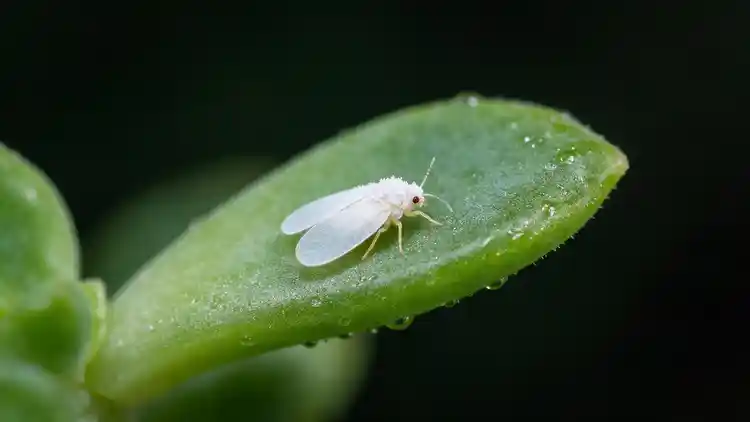
Whiteflies are small, sap-sucking insects (not true flies) that cluster on the undersides of leaves and scatter in a visible white cloud when disturbed. They damage plants by draining sap, causing yellowing and leaf drop, and excreting sticky honeydew that leads to sooty mold.
The most effective control combines yellow sticky traps, insecticidal soap or neem oil applied to leaf undersides every 5–7 days, and removal of heavily infested leaves — with severe infestations sometimes requiring systemic insecticides as a last resort.
Learn more about Pest Disease and Management >
Introduction: A Small Pest With Outsized Impact
If you’ve ever brushed against a houseplant or tomato leaf and watched a puff of tiny white insects lift into the air, you’ve met whiteflies.
Despite the name, whiteflies aren’t true flies — they’re more closely related to aphids and scale insects, belonging to the order Hemiptera.
What makes them such a persistent garden and houseplant problem is their combination of rapid reproduction, mobility, and resistance to many common pesticides once populations are established.
Whiteflies affect an enormous range of plants — from indoor favorites like hibiscus, fuchsia, and poinsettia to outdoor vegetable staples like tomatoes, peppers, squash, and beans.
Understanding their life cycle is the key to breaking it, since most whitefly treatments fail simply because they target adults while ignoring eggs and nymphs.
Identifying Whiteflies: What to Look For
Visual Signs
Adults: Tiny (1/16 inch), moth-like insects with white, powdery wings. They cluster on the undersides of leaves and fly up in a cloud when the plant is disturbed.
Nymphs: Flat, oval, translucent-to-yellowish scale-like insects attached to the underside of leaves — often mistaken for a natural leaf texture since they don’t move once settled.
Eggs: Tiny, spindle-shaped, laid in circular or scattered clusters on leaf undersides, often invisible without magnification.
Plant Damage Signs
Yellowing, stippled, or curling leaves
Stunted growth and reduced yield in vegetables
Sticky residue (honeydew) on leaves and surfaces beneath the plant
Sooty mold — a black fungal growth that develops on honeydew deposits, blocking photosynthesis
Rapid, unexplained leaf drop in houseplants
How to Confirm Whiteflies vs. Other Pests
Gently shake or tap an infested plant. If small white insects burst upward in a cloud and resettle within a minute or two, it’s whiteflies.
Aphids, by contrast, don’t fly this way, and spider mites produce fine webbing rather than a visible flying cloud.
The Whitefly Life Cycle
Understanding the life cycle explains why single treatments often fail:
Egg stage (5–10 days): Laid on the underside of young leaves; not affected by contact insecticides since they’re often laid in leaf tissue crevices.
Nymph stage (2–4 weeks, four instars): Nymphs are largely immobile after the first “crawler” stage and feed continuously on sap. Most sprays are only effective against early nymph stages.
Pupal stage: A non-feeding, hardened stage that is highly resistant to most contact pesticides.
Adult stage: Emerges and begins reproducing within days, with females capable of laying 200–400 eggs over their lifespan.
At room temperature or warm outdoor conditions, whiteflies can complete an entire generation in as little as 3 weeks, which is why infestations explode quickly and why a single spray rarely solves the problem — new eggs hatch after the treatment window closes.
Why Whiteflies Are Especially Common on Houseplants
Indoor environments often lack the natural predators (parasitic wasps, ladybugs, lacewings) that keep whitefly populations in check outdoors. Consistent indoor warmth also removes the seasonal die-off that naturally interrupts outdoor whitefly cycles.
Houseplants most frequently affected include:
Hibiscus
Fuchsia
Poinsettia
Lantana
Gardenia
Tomato and pepper seedlings started indoors
New plants brought in from nurseries are a common introduction point — whiteflies or their eggs can hitchhike on foliage that looks clean at a glance.
Whiteflies on Vegetables: Which Crops Are Most Vulnerable
Tomatoes
High
Also a vector for tomato yellow leaf curl virus in some whitefly species
Peppers
High
Symptoms include leaf yellowing and reduced fruit set
Squash & Cucumbers
Moderate–High
Large leaf surface area attracts heavy colonization
Beans
Moderate
Can transmit bean golden mosaic virus in warm climates
Sweet Potatoes
High
A preferred host in warm-season gardens
Brassicas (cabbage, kale)
Lower
Occasionally affected but less preferred
Beyond direct sap-feeding damage, certain whitefly species (notably the silverleaf whitefly, Bemisia tabaci) are known disease vectors, capable of transmitting plant viruses between crops as they feed — making early control especially important in vegetable gardens.
Treatment for Whiteflies : Step-by-Step Control Plan
Step 1: Isolate and Inspect (Houseplants)
Move any infested houseplant away from other plants immediately to prevent spread. Inspect all nearby plants, since whiteflies move readily between neighboring foliage.
Step 2: Physical Removal
Rinse leaves (especially undersides) with a strong stream of water to knock off adults and nymphs.
Prune and discard heavily infested leaves — don’t compost them, as eggs and nymphs can survive.
Wipe leaves with a damp cloth for light infestations on smooth-leaved houseplants.
Step 3: Yellow Sticky Traps
Whiteflies are strongly attracted to the color yellow. Placing yellow sticky traps just above the plant canopy captures flying adults and is one of the most effective ways to monitor and reduce population size, especially indoors.
Step 4: Insecticidal Soap or Neem Oil
Apply insecticidal soap or neem oil directly to the undersides of leaves, where whiteflies live and feed — spraying only the tops of leaves misses the infestation almost entirely. These treatments work on contact and must be reapplied every 5–7 days for 3–4 weeks to break the egg-to-adult cycle, since they don’t kill eggs.
Step 5: Introduce Beneficial Insects (Outdoor/Greenhouse)
Encarsia formosa (a parasitic wasp) is widely used in greenhouse and organic vegetable production to target whitefly nymphs specifically.
Ladybugs and lacewings feed on whitefly nymphs and eggs and can help suppress outdoor populations.
Step 6: Systemic Insecticides (Severe Infestations Only)
For infestations that don’t respond to soap, oil, or traps, systemic insecticides containing imidacloprid or similar active ingredients can be applied as a soil drench, which the plant absorbs and distributes through its tissue.
This method should be used sparingly and as a last resort, particularly on edible crops, due to impacts on pollinators — always follow label instructions regarding pre-harvest intervals on vegetables.
Prevention: Stopping Whiteflies Before They Start
Quarantine new plants for 1–2 weeks before placing them near existing houseplants or garden beds.
Inspect leaf undersides regularly, especially in warm months, since early detection prevents population explosions.
Avoid over-fertilizing with nitrogen, which produces soft, lush growth that whiteflies preferentially colonize.
Use reflective mulch (silver or aluminum-coated) in vegetable gardens, which has been shown to disorient and repel whiteflies from landing on crops.
Maintain plant spacing to improve airflow, since dense, crowded plantings create ideal humid conditions for whitefly populations to thrive.
Encourage natural predators in outdoor gardens by planting pollen- and nectar-rich flowers that support parasitic wasps and lacewings.
Organic vs. Chemical Treatment Comparison
Water spray
For light infestations
Immediate, temporary action
Needs repeating
Yellow sticky traps
Best for monitoring & adult capture
Ongoing action needed
Doesn’t address eggs/nymphs
Insecticidal soap
Houseplants & vegetables
5–7 days per cycle
Must contact insect directly
Neem oil
Houseplants & vegetables
5–7 days per cycle
Also has some repellent effect
Beneficial insects
Greenhouse & outdoor gardens
Weeks to work
Best for long-term balance
Systemic insecticide
Severe, unresponsive infestations
Days to work
Use only as last resort on edibles
Frequently Asked Questions
1. What causes whiteflies on houseplants?
Whiteflies are most often introduced through new plants brought in from nurseries, and they thrive indoors because homes lack the natural predators and seasonal temperature drops that control populations outdoors.
2. Are whiteflies harmful to vegetable plants?
Yes — whiteflies damage vegetables by draining sap, which causes yellowing and reduced yield, and certain species can also transmit plant viruses between crops as they feed.
3. How do you get rid of whiteflies naturally?
Effective natural methods include spraying leaf undersides with insecticidal soap or neem oil every 5–7 days, using yellow sticky traps to capture adults, and introducing beneficial insects like Encarsia formosa or ladybugs.
4. Why do whiteflies keep coming back after treatment?
Most whitefly treatments only kill adults and early nymphs, not eggs or pupae, so a single treatment misses part of the life cycle — repeated applications over 3–4 weeks are needed to fully break the cycle.
5. Can whiteflies spread from houseplants to garden vegetables?
Yes, whiteflies can move between houseplants placed outdoors and nearby vegetable plants, which is why quarantining new or previously infested plants before placing them near a garden is recommended.
6. Do whiteflies bite humans?
No, whiteflies feed exclusively on plant sap and do not bite or harm humans or pets.
Conclusion
Whiteflies are one of the most persistent pests a gardener will encounter, precisely because their life cycle outpaces a single round of treatment.
The most reliable control combines multiple tactics at once — physical removal, yellow sticky traps, and consistent leaf-underside applications of soap or neem oil over several weeks — rather than relying on any single method.
Catching an infestation early, quarantining new plants, and supporting natural predators outdoors will do more to protect your houseplants and vegetables long-term than any single spray ever could.