A hose that kinks halfway across the lawn or barely reaches the vegetable beds can turn a peaceful watering routine into a daily frustration.
This garden hose buying guide will help you choose a hose that fits your space, water pressure, and gardening goals, whether you are tending patio containers, a pollinator border, or a backyard full of tomatoes.
The best garden hose is not automatically the thickest, longest, or most expensive option.
It is the one you can move comfortably, connect without leaks, and use often enough to keep your plants consistently hydrated.
Start with the shape of your garden, then look closely at hose length, diameter, material, fittings, and storage.
Start With the Right Hose Length
Measure before you shop. Walk from the outdoor faucet to the farthest place you regularly water, following the route the hose will actually take around corners, beds, patios, and shrubs.
Then add a little room for movement. A hose that is just a few feet too short creates needless tugging on plants and connections.
For a compact patio, balcony, or small courtyard, a 25-foot hose may be plenty. Many average suburban yards work well with a 50-foot hose. A 75- or 100-foot hose can make sense for large lots, long driveways, or gardens set well behind the house.
Still, longer is not always better. Every extra foot adds weight, takes up storage space, and can slightly reduce water flow. If you maintain separate front and back gardens, two shorter hoses may be easier to manage than one heavy 100-foot model.
You can also use a short leader hose between the faucet and a hose reel, leaving your main hose ready for watering.
Choose a Hose Diameter for Your Watering Needs
Hose diameter affects how much water can travel through the hose at once. The most common choice is 5/8 inch, and for good reason.
It offers strong flow for sprinklers, spray nozzles, soaker hoses, and general hand-watering without being overly bulky.
A 1/2-inch hose is lighter and easier to carry, which can be a real advantage for container gardeners or anyone with limited strength.
The trade-off is lower water volume. It is usually fine for watering a few pots, but it may feel slow when filling a large watering can or running a sprinkler across a thirsty lawn.
A 3/4-inch hose delivers more water and suits bigger landscapes, long hose runs, and jobs such as filling a stock tank or quickly soaking newly planted trees. I
t is also heavier, more expensive, and often more than a small home garden needs.
If your faucet has weak pressure, a wider hose cannot create pressure that is not there, but it can reduce restriction along a long run.
Garden Hose Buying Guide: Pick the Best Material
The hose material determines its flexibility, durability, weight, and price. Consider how often you water, how hot your summers get, and where the hose will live between uses.
Vinyl hoses are light and budget-friendly
Vinyl hoses are generally inexpensive and easy to handle. They can be a sensible choice for occasional use in a small garden, especially if you will store the hose out of direct sun.
Their weakness is durability. Thin vinyl may kink, crack, or become stiff during temperature swings, so it is not the best match for a hose that will be dragged over gravel every day.
Rubber hoses handle hard work
Rubber hoses are durable, flexible, and better able to tolerate hot pavement and frequent use. They are a strong choice for established gardens, busy family yards, and gardeners who want a hose that can last for years with proper care.
The downside is weight. A 50-foot rubber hose can be tiring to pull around a large yard, particularly when full of water.
Hybrid hoses balance flexibility and weight
Hybrid hoses combine materials, often rubber and polymer, to create a more manageable middle ground.
Many remain flexible in both heat and cooler weather while weighing less than all-rubber options.
For most home gardeners, a quality hybrid hose is a practical sweet spot: sturdy enough for regular watering but not so heavy that it stays coiled in the corner.
Expandable hoses save space, with limits
Expandable hoses grow longer when filled with water and shrink for compact storage. They are wonderfully convenient for apartment patios, small decks, and gardeners who need to tuck equipment into a closet or storage bin.
However, they are not ideal for every job. Their lightweight construction can be more vulnerable to punctures, and they may not work as reliably with sprinklers, high water pressure, or frequent heavy-duty use.
If drinking water safety matters in your household, look for a hose labeled drinking-water safe or lead-free.
This is especially worthwhile when filling pet bowls, rinsing harvested vegetables, or letting children play in the sprinkler. A standard garden hose is not automatically made for potable water.
Look Closely at Fittings and Kink Resistance
A strong hose can still be annoying if its connections leak.
Choose solid metal fittings, preferably brass, rather than thin plastic ends that can crack when tightened or dropped.
Brass resists corrosion and creates a dependable seal with common outdoor faucets, nozzles, and sprinklers.
Crush-resistant couplings are helpful if your hose will be rolled onto a reel, driven over accidentally, or stored in a busy garage.
A protective collar near each end can also reduce kinking where the hose bends most sharply.
No hose is completely kink-proof.
Marketing labels can be optimistic, especially when a hose is tightly coiled, pulled around a tree, or left in a hot heap on the driveway.
A flexible hose with a good outer jacket will resist kinks better, but proper use matters too. Uncoil it fully before watering, avoid sharp turns, and drain it before winding it up.
Match the Hose to How You Water
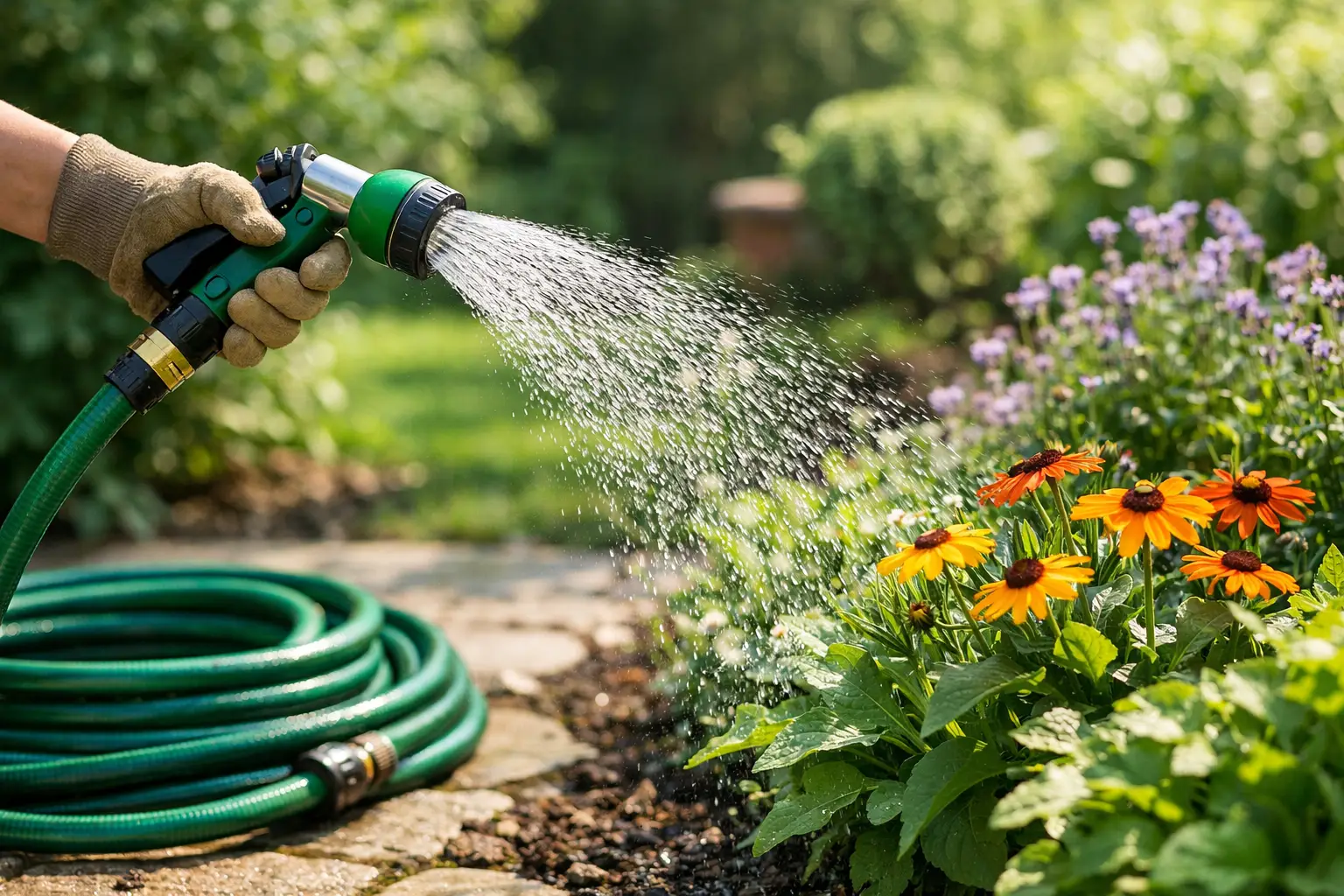
A standard drinking-water-safe hose paired with an adjustable nozzle is the most versatile setup for most gardens.
A gentle shower setting works well for seedlings and freshly planted annuals, while a stronger stream can rinse tools or fill buckets.
For watering at the base of vegetables, shrubs, and perennials, connect a soaker hose or drip system to conserve water and keep foliage drier.
Soaker hoses slowly release water along their length, which can be useful in long vegetable rows and foundation beds.
They need low pressure to work well, so use a pressure regulator if recommended. They are less useful for containers, scattered plantings, or lawns where coverage needs to be broad and even.
Flat hoses are easy to store but can twist and are usually best for lighter use. Coiled hoses retract neatly near a door or potting bench, though their reach is limited and they can pull at your hand while watering.
Consider these specialty styles as helpful tools for specific spaces, not one-size-fits-all replacements for a dependable main hose.
Do Not Forget Storage and Seasonal Care
Even a great hose will wear out early if it spends every season baking in the sun or freezing with water inside.
A hose reel, wall-mounted hanger, or storage pot keeps it off the ground, reduces tangles, and makes the garden look more organized.
Choose a reel that fits the hose length and diameter you plan to buy. An undersized reel creates its own daily battle.
Before winter temperatures arrive, disconnect the hose, drain it completely, and store it in a shed, garage, or protected area.
Water left inside can freeze and damage both the hose and the outdoor faucet. During the growing season, check washers inside the fittings whenever you notice drips.
Replacing a small rubber washer is often all it takes to stop a wasteful leak.
A Smart Choice for Your Garden
For many home gardeners, a 50-foot, 5/8-inch hybrid hose with brass fittings offers the best balance of reach, flow, durability, and comfort. B
ut a compact container garden may be happier with a light 25-foot hose, while a sprawling yard may call for a heavier-duty option or two watering zones.
Choose the hose that makes watering feel easy enough to become part of your rhythm.
When the right tool is hanging within reach, those early morning vegetable checks and evening strolls through the flowers become a little more enjoyable – and your garden gets the steady care it needs to thrive.
See also:
Guide to Choosing the Perfect Garden Hose for Your Yard >
Gardening Tools & Equipment >