A sunny windowsill can keep many plants alive, but it rarely provides the steady, bright light that seedlings, herbs, and fruiting vegetables need.
Learning how to choose grow lights means looking beyond a package’s impressive wattage claim and matching the fixture to what you want to grow, where you want to grow it, and how much attention you can give it.
The good news is that indoor lighting has become far more gardener-friendly.
A well-chosen light can turn a shelf, spare corner, or kitchen counter into a genuinely productive green space.
The trick is choosing enough useful light without overheating plants, wasting electricity, or buying a fixture that only brightens the room.
Start With the Plants You Want to Grow
Your plant’s natural light needs should guide every other decision. A low-light houseplant such as a pothos, snake plant, or ZZ plant can do well under a modest supplemental light. It may only need extra brightness through winter or in a dim room.
Herbs, leafy greens, most houseplant cuttings, and young seedlings need more.
Basil, cilantro, lettuce, and pepper seedlings grow best when the light is bright and close enough to prevent lanky, stretched stems.
Fruiting crops such as tomatoes, peppers, cucumbers, and strawberries are the most demanding.
They need intense light for healthy growth and a worthwhile harvest, especially if they have no meaningful sunlight from a window.
Think of a grow light as a food source, not a decorative lamp. A small clip-on light can support one herb pot.
It will not power a tray of tomato seedlings or replace summer sunshine for a mature pepper plant.
How to Choose Grow Lights by Type
For most home gardeners, LED grow lights are the practical choice.
They use less electricity than older technologies, produce relatively little heat, last a long time, and come in shapes suited to shelves, counters, hanging planters, and seed-starting racks.
You will commonly see four fixture styles:
- Bulb-style lights fit into a standard lamp or clamp fixture and work well for one or two plants.
- Bar lights spread light evenly across shelves, windowsills, and narrow seed-starting setups.
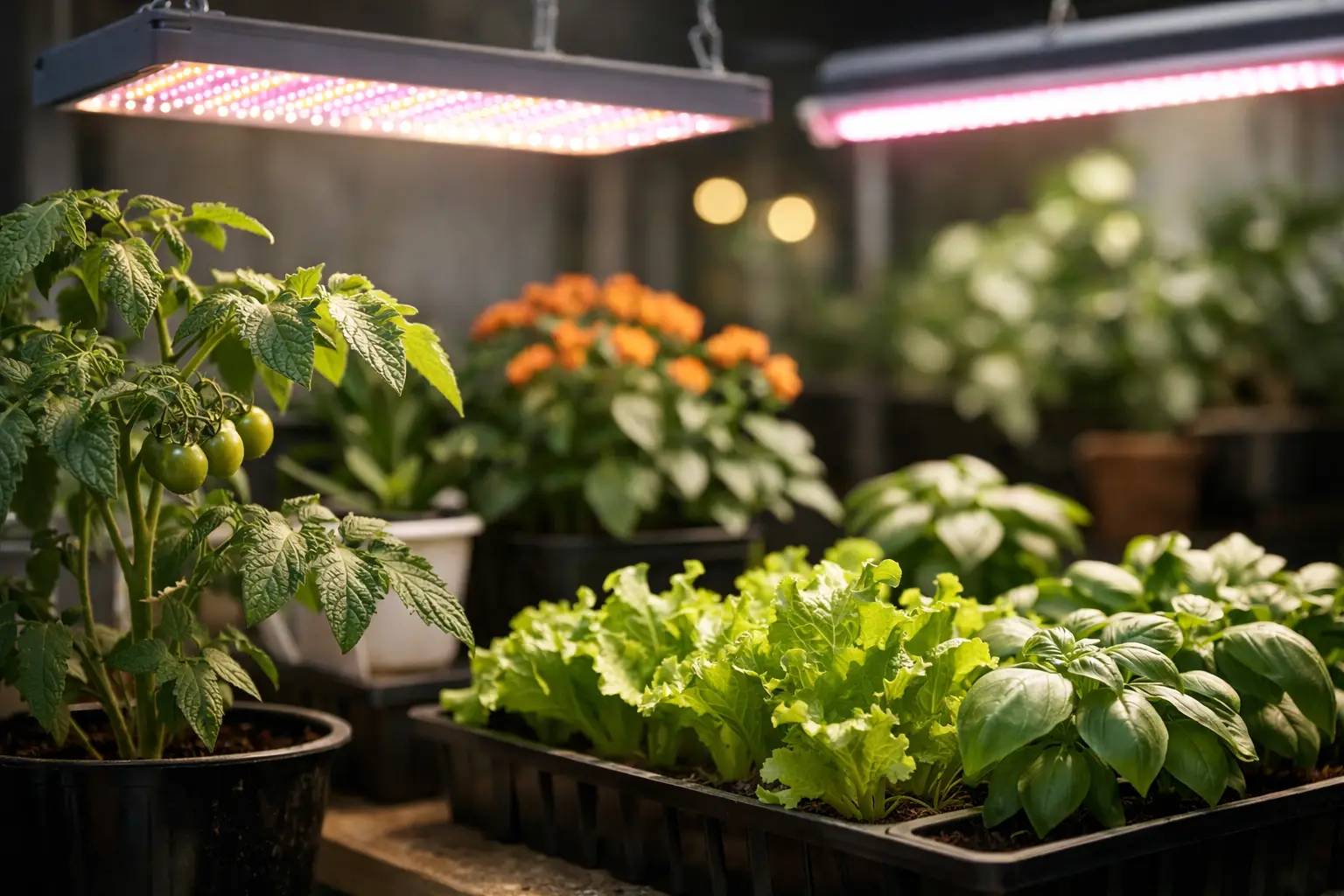
- Panel lights cover a larger area and are useful for trays of seedlings or compact indoor gardens.
- Hanging fixtures are designed for stronger light needs, including larger herb gardens and fruiting vegetables.
Fluorescent shop lights can still raise healthy seedlings, especially if you already own the fixture.
They are usually less efficient than LEDs and need closer placement, but they remain a workable budget option.
High-intensity discharge lights, such as metal halide and high-pressure sodium fixtures, can grow demanding crops, yet their heat and power use make them a less appealing fit for most homes.
Ignore “Equivalent Watts” and Look for Useful Specs
Packaging can be confusing because some brands highlight the wattage their product supposedly replaces rather than the electricity it actually uses.
A claim such as “equivalent to 1,000 watts” does not tell you how much usable light reaches your plants.
First, check the fixture’s actual power draw in watts.
This helps estimate energy use, but wattage alone does not measure plant-ready light.
Then look for PPFD, short for photosynthetic photon flux density. It measures the light that reaches a surface where leaves sit, usually expressed in micromoles per square meter per second.
For a beginner-friendly rule of thumb, aim for roughly 100 to 200 PPFD for low-light foliage plants, 200 to 400 for leafy greens and seedlings, and 400 to 600 or more for herbs and fruiting crops.
These numbers depend on how long the light runs each day. A plant receiving moderate light for 14 hours may be happy, while the same plant under a weak lamp for 14 hours may still struggle.
If a manufacturer does not provide PPFD information, look carefully at the listed coverage area and hanging height.
Be skeptical of a tiny fixture claiming to cover a huge growing space. Light intensity falls quickly as a lamp moves farther from leaves.
Choose the Right Spectrum and Color
Plants use a broad range of visible light, so a full-spectrum LED is an easy, versatile choice for most indoor gardens.
It generally appears white or slightly pink-white, making it easier to inspect foliage, spot pests, and enjoy your plants in a living space.
Purple or “blurple” lights combine heavy amounts of blue and red light.
They can grow plants, but their color can make a room feel less inviting and makes it harder to judge true leaf color.
Unless you are building a dedicated grow area and prefer that style, full-spectrum white light is usually the more pleasant option.
Blue-leaning light supports compact leafy growth, while red light contributes to flowering and fruiting.
You do not need to chase a complicated spectrum chart for everyday gardening. Choose a quality full-spectrum fixture, then focus on intensity, coverage, and placement.
Those factors often make the bigger difference.
Match Coverage to Your Growing Area
Measure the actual space your plants occupy before buying a light. A 24-inch shelf needs a fixture that lights the full shelf, not just the plants directly beneath its center.
Uneven coverage leads to a familiar indoor-garden problem: lush plants in the middle and pale, leaning plants at the edges.
For a single plant, a bulb or small spotlight may be enough. For seed trays, bar fixtures often provide the most even coverage.
For a larger tabletop garden, one panel may work, but two smaller fixtures can give you more control over bright and dim zones.
Check whether the manufacturer’s stated coverage is meant for vegetative growth or flowering. A light may cover a larger area for low-demand foliage than it can for tomato or pepper production. When in doubt, choose coverage based on the more demanding crop you plan to grow.
Plan for Height, Heat, and Adjustability
A powerful fixture hung too close can bleach leaves, curl edges, and dry out tender seedlings.
A weak fixture placed too high produces thin, floppy growth. The ideal distance varies by fixture, so begin with the manufacturer’s recommendation and watch how plants respond for a week or two.
Many LED bars can sit 6 to 12 inches above seedlings and leafy greens, while stronger panels may need more distance.
Adjustable chains, cords, or shelf mounts are worth having because plant height changes quickly. You should be able to raise the light as seedlings grow without rebuilding your setup.
Even LEDs produce some heat. Make sure there is airflow around the fixture and avoid placing it where water can drip into electrical components.
If the grow area feels hot at leaf level, raise the light, improve ventilation, or reduce the daily run time.
Add a Timer and Keep a Realistic Schedule
Plants need darkness, too. Most houseplants, herbs, greens, and seedlings do well with 12 to 16 hours of light each day.
A simple outlet timer takes the guesswork out of the routine and prevents the common habit of leaving lights on around the clock.
Start seedlings with 14 to 16 hours of light. For foliage houseplants receiving some window light, 10 to 12 supplemental hours may be enough.
Fruiting plants often benefit from 14 to 16 bright hours, provided the fixture is strong enough and the plant has a consistent dark period.
A built-in timer is convenient, but a separate timer can be just as effective and may give you more flexibility.
What matters most is consistency. Plants respond better to a dependable schedule than to occasional bursts of extra light.
Consider Energy Use Before Building a Big Setup
A grow light is only helpful if you feel comfortable running it every day.
To estimate cost, multiply the fixture’s actual wattage by the hours it runs, then compare that usage with your local electricity rate.
A 40-watt LED running 14 hours daily uses far less electricity than a large, high-output fixture, but it may also support far fewer plants.
For renters, apartment gardeners, and anyone starting small, a modest shelf setup is often the smart first step.
Grow herbs, greens, or seedlings successfully, learn how your space behaves, and expand when you know what you enjoy growing. A compact indoor garden can be surprisingly productive without taking over the living room.
Watch Your Plants and Adjust
Your plants will tell you whether the lighting plan is working. Stretched stems, large gaps between leaves, slow growth, and plants leaning hard toward a window usually signal insufficient light.
Bleached patches, crispy leaf edges, and curling leaves can point to excessive intensity or heat.
Adjust one variable at a time: move the fixture a few inches, add an hour of light, or rotate plants for more even exposure.
Keep a quick note of what changes you make, especially with seedlings and herbs. That small habit makes it much easier to recognize what your indoor garden likes.
The best grow light is not necessarily the biggest or brightest one.
It is the fixture that fits your plants, your growing area, and your daily routine well enough that you will use it consistently.
Start with one bright, well-placed light, enjoy the fresh growth it brings, and let your new green corner show you where to grow next.