A raised bed can look beautifully built and still disappoint if what is inside it is little more than bagged dirt.
The best soil for raised beds is not a single product or a mysterious recipe. It is a loose, fertile blend that gives roots air, moisture, nutrients, and room to spread.
That matters because raised beds do not behave like in-ground gardens. They warm up faster, drain more quickly, and depend entirely on the growing medium you provide.
Build the soil well from the start, and your tomato plants, salad greens, herbs, and flowers get a much friendlier place to call home.
See also: A Step-by-Step Guide to Building a Raised Bed Garden >
What Is the Best Soil for Raised Beds?
For most vegetable, herb, and flower gardens, the best soil for raised beds is a blend of roughly 60% quality topsoil and 40% compost.
This combination has enough mineral soil to anchor plants and hold water, while compost supplies nutrients, beneficial organisms, and the crumbly texture gardeners love.
If your bed is especially deep, you can use less expensive filler in the bottom portion, then reserve this premium growing mix for the top 12 to 18 inches where most annual vegetable roots will grow.
Keep in mind that root crops, tomatoes, peppers, and perennial plants appreciate a deeper zone of consistently good soil.
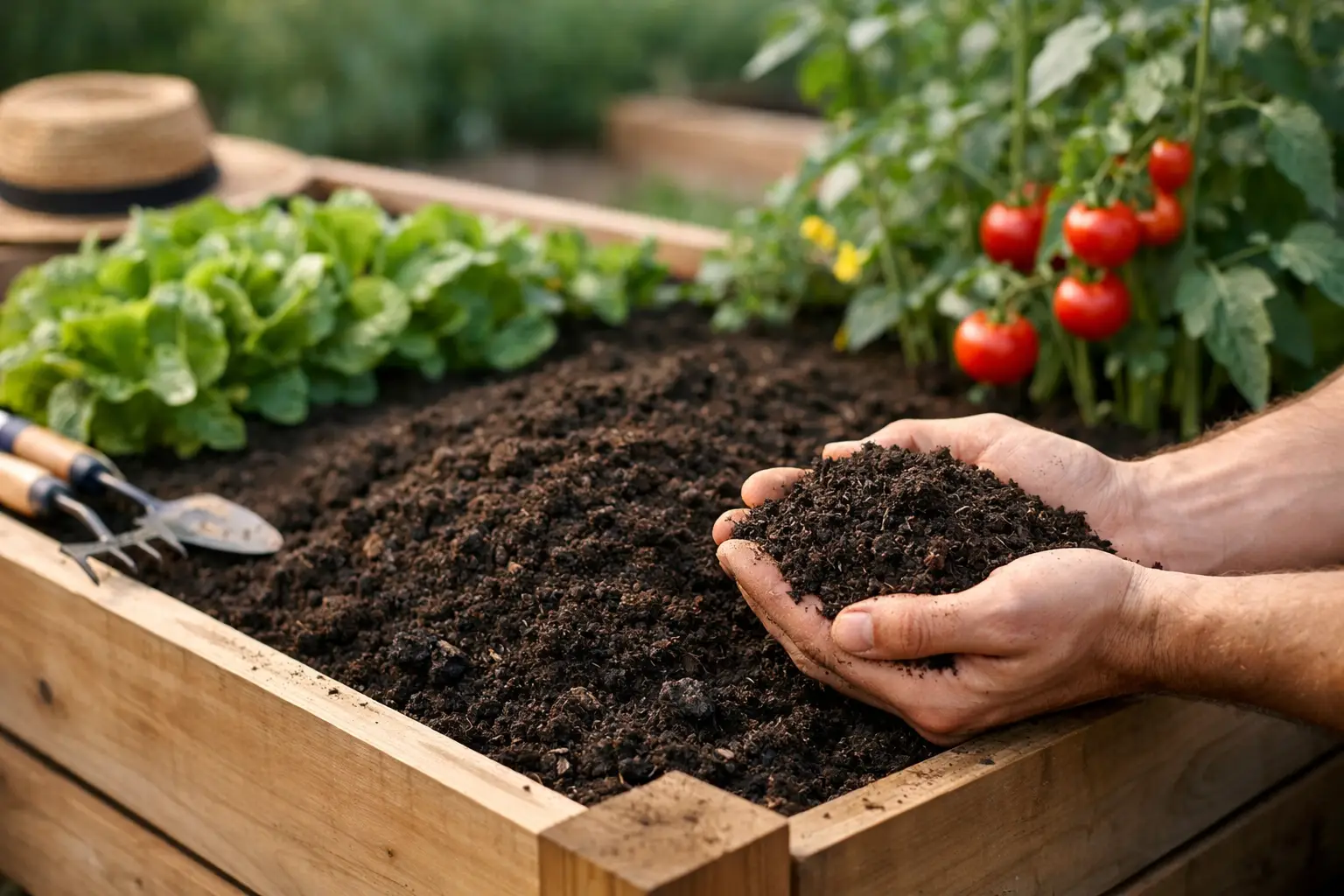
A good raised-bed mix should feel dark and fluffy rather than sticky, dusty, or packed hard.
When you squeeze a damp handful, it should hold together briefly, then crumble apart with a gentle poke.
That is the sweet spot: enough moisture retention for summer heat, with enough drainage to prevent soggy roots.
The Three Ingredients That Matter Most
1. Quality topsoil provides the foundation
Topsoil is the mineral-based portion of your mix. It adds sand, silt, and clay particles that help retain moisture and nutrients.
Choose screened topsoil from a reliable landscape supplier when possible. It should be free of large rocks, construction debris, and persistent weeds.
Avoid using soil dug directly from your yard as the main ingredient. Native soil can be heavy, compacted, low in organic matter, or filled with weed seeds.
It can still be useful in small amounts, especially if it is naturally loamy and you know its history, but it rarely creates the light texture raised-bed plants need on its own.
2. Compost feeds the soil, not just the plants
Compost is where a raised bed begins to feel alive. It improves structure, helps soil hold moisture during dry spells, and encourages the organisms that turn nutrients into forms plants can use.
Use finished compost that smells earthy and looks dark and crumbly. Compost made from yard waste, leaves, food scraps, mushroom compost, or well-aged manure can all work.
If you are buying bags, mixing two different compost sources is often a smart move because each one brings a slightly different nutrient profile and texture.
More compost is not always better.
A bed filled entirely with compost can settle dramatically, dry out unevenly, and sometimes contain excessive salts or nutrients.
Aim for about 30% to 40% compost in a new bed, then add a thinner layer each year to refresh it.
3. Aeration material helps in heavy mixes
If your topsoil is clay-heavy or your purchased blend feels dense, add an aeration ingredient. Coarse sand, pumice, rice hulls, or perlite can help create pore spaces so water drains and roots can breathe.
Coarse builder’s sand is useful in small amounts, but do not try to fix clay by adding a little fine sand.
That combination can create a hard, cement-like texture. For a typical home raised bed, compost and a high-quality blended topsoil usually solve most drainage issues without extra ingredients.
A Simple Raised-Bed Soil Recipe
For a new raised bed, start with six parts screened topsoil and four parts finished compost. Blend the materials as evenly as you can before planting.
If the mix seems heavy, add up to one part pumice, perlite, or rice hulls for every 10 parts of the finished blend.
This recipe works for many popular crops, including beans, cucumbers, lettuce, basil, zinnias, marigolds, peppers, and tomatoes. It is flexible, which is exactly what a busy home garden needs.
For beds dedicated to carrots, beets, or other roots, remove rocks and clumps carefully.
A deeper, finer-textured mix helps roots grow straight instead of twisting around obstacles.
For moisture-loving plants such as leafy greens, lean toward the higher end of the compost range.
For lavender, rosemary, and other Mediterranean herbs, use less compost and add more grit or pumice to improve drainage.
Fill a Deep Bed Without Wasting Great Soil
A 24-inch or taller raised bed can require a surprising amount of material. Filling every inch with premium soil is expensive, and it is not necessary for shallow-rooted crops.
You can place untreated logs, branches, leaves, pine needles, or clean wood chips in the bottom third of a very deep bed.
This approach saves soil and slowly breaks down over time. Water the materials well as you build, then cover them with at least 12 to 18 inches of your topsoil-and-compost mix.
There is a trade-off. Woody material settles as it decomposes, so the soil level may drop over the next few seasons. It can also temporarily use nitrogen near the decomposition zone.
Keeping plenty of finished compost in the upper growing layer prevents this from becoming a problem for most annual crops.
Do not use pressure-treated lumber scraps, painted wood, trash, glossy cardboard, or anything you would not want near edible plants.
If your goal is a productive, low-waste garden, clean natural materials are the better choice.
Skip These Common Raised-Bed Soil Mistakes
Potting mix is excellent for containers, but it is usually too lightweight and costly for a large raised bed. It may contain a lot of peat moss, coconut coir, perlite, and fertilizer, all of which can be useful in pots but may dry out or break down too quickly in a big outdoor bed.
Straight bagged garden soil can also be hit or miss. Some products are mostly compost, while others are dense and woody.
Read the bag, feel the material if possible, and think of bagged soil as one ingredient in a blend rather than the whole answer.
Avoid creating drainage layers of gravel at the bottom of a raised bed. Gravel does not improve drainage in the way many gardeners expect.
Instead, it takes up valuable root space and can cause water to collect where the fine soil meets the coarse layer. A consistently loose soil mix from top to bottom works better.
Finally, do not forget that soil settles. A new bed may drop several inches after watering and a few weeks of natural settling. Fill it slightly above the desired level, then top it off after the first season.
How to Keep Raised-Bed Soil Productive Each Year
Raised-bed soil gets better when you treat it as a living resource instead of something you replace.
At the start of each growing season, spread one to two inches of finished compost across the surface. Gently work it into the top few inches, or let earthworms and watering draw it down over time.
Mulch is another quiet helper. A two- to three-inch layer of shredded leaves, straw, or untreated fine wood chips around established plants slows evaporation, softens temperature swings, and limits weeds. Keep mulch a little away from plant stems to discourage rot and pests.
Crop rotation also helps, even in a small space. Rather than growing tomatoes in the exact same spot every year, follow heavy-feeding fruiting plants with beans, peas, herbs, or leafy greens. If a crop struggled with disease, move that plant family to another bed the following season.
A basic soil test every few years can remove much of the guesswork. Compost improves many problems, but it cannot automatically correct a very high or low pH, phosphorus buildup, or a missing nutrient.
Testing is especially worthwhile when plants look pale, yields shrink, or amendments do not seem to help.
See also: The Importance of Soil Testing for Healthy Agriculture >
Build Soil That Makes Gardening Easier
The goal is not to chase a perfect bag or an exact recipe forever.
Start with a generous blend of screened topsoil and finished compost, adjust for the plants you love to grow, and add organic matter each season.
Your raised bed will settle, change, and improve along with your gardening skills.
Give that soil a little care, and it will return the favor with easier planting days, fuller harvest baskets, and a greener retreat right outside your door.