Compost is one of those garden essentials that sounds wonderfully simple until you actually have to buy it.
You know you need compost. You may even know exactly where you want to put it. But then comes the tricky question: how much compost do I need?
I’ve definitely found myself standing in a garden centre trying to work out whether three bags will be plenty or whether I’m about to get halfway through a raised bed and realise I should have bought ten.
The good news is that calculating compost quantities is much easier than it first appears. Once you know the size of the area you’re covering and how deeply you want to apply the compost, you can work out a fairly accurate amount before you spend any money.
View more How To Guides >
In this guide, I’ll explain how much compost you need for raised beds, vegetable gardens, flower borders, lawns, pots and containers, as well as how to calculate quantities yourself.
View Compost Options on Amazon.com >
Why Getting the Amount of Compost Right Matters
There is nothing particularly disastrous about buying slightly too much compost. You can usually find somewhere else in the garden to use it.
Buying far too little, however, is frustrating.
Compost may be used to:
Improve poor or depleted soil
Add organic matter
Mulch flower beds and borders
Fill raised beds
Grow vegetables
Improve moisture retention
Help heavy soils become easier to work
Feed soil organisms
Top-dress lawns
Refresh containers and pots
The amount needed depends heavily on what you’re using it for.
A light layer over established soil might only need an inch or so of compost, while filling a completely empty raised bed could require hundreds of litres.
That difference is why there isn’t one universal answer to the question, “How much compost do I need?”
See also: How Much Mulch Do You Really Need? A Step-by-Step Calculation Guide >
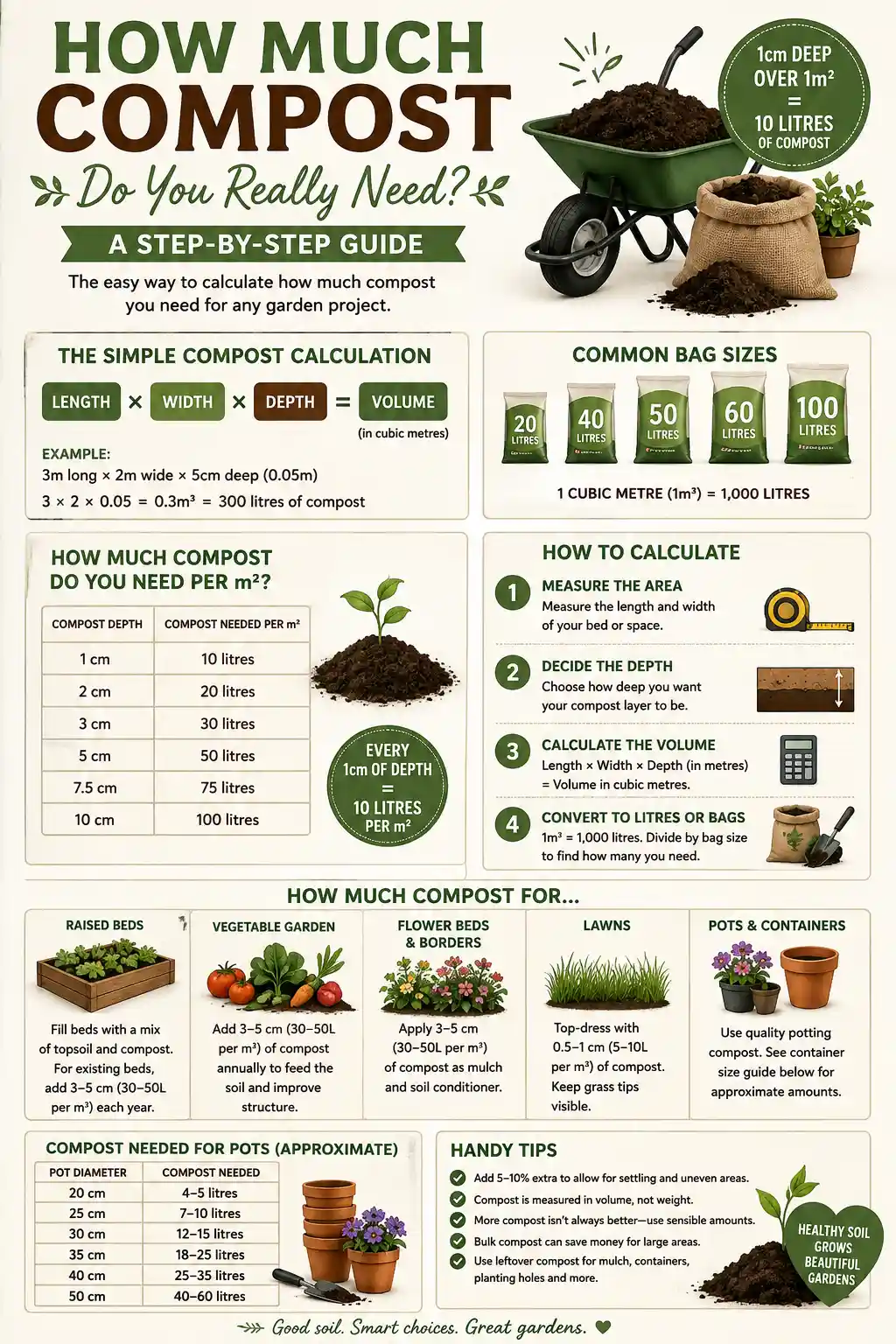
The Simple Compost Calculation
The basic calculation is:
Length × Width × Compost Depth = Volume of Compost
The important part is making sure all your measurements use the same units.
For example, imagine you have a bed measuring:
3 metres long
2 metres wide
5 centimetres deep
First convert 5cm into metres:
5cm = 0.05m
Then calculate:
3 × 2 × 0.05 = 0.3 cubic metres
One cubic metre contains 1,000 litres.
So:
0.3 cubic metres = 300 litres of compost
If your compost comes in 50-litre bags:
300 ÷ 50 = 6 bags
You would therefore need approximately six 50-litre bags of compost.
I usually recommend adding a small margin for error rather than buying the exact calculated amount.
Quick Compost Depth Guide
Before calculating anything, decide how deep your compost layer needs to be.
As a rough guide:
| Garden Use | Typical Compost Depth |
|---|---|
| Light soil improvement | 2–3 cm |
| Annual soil improvement | 3–5 cm |
| Heavy soil improvement | 5–10 cm |
| Mulching borders | 5–7.5 cm |
| Vegetable beds | 3–5 cm |
| No-dig vegetable beds | Around 5 cm annually |
| New raised beds | Depends on total bed depth |
| Lawn top-dressing | 0.5–1 cm |
These figures don’t have to be exact. Compost doesn’t need to be measured with laboratory precision.
They simply give you a sensible starting point.
Step 1: Measure the Area
Start by measuring the length and width of the garden area.
For a rectangular bed:
Length × Width = Area
For example:
4m × 2m = 8 square metres
If you have an irregularly shaped border, divide it mentally into smaller rectangles or squares, calculate each section and then add them together.
For circular beds, use:
π × radius²
Don’t worry if the measurements aren’t perfect. Garden beds rarely have perfectly straight edges anyway.
I normally round slightly upwards.
Step 2: Decide How Deep You Need the Compost
This is where many compost calculations go wrong.
You aren’t simply covering an area—you are filling a volume.
A 5cm layer requires five times as much compost as a 1cm layer.
For established beds where I’m simply improving the soil, I would normally spread somewhere around 3–5cm of compost.
For mulching, I generally prefer a slightly deeper layer.
If you’re trying to improve particularly poor ground, you may want considerably more.
Step 3: Calculate the Volume
Once you know the area and depth, multiply them together.
Suppose your vegetable bed measures:
5m × 1.2m
The area is:
5 × 1.2 = 6m²
You want a 5cm layer of compost.
Convert 5cm to metres:
5cm = 0.05m
Now calculate:
6 × 0.05 = 0.3m³
Therefore you need:
300 litres of compost
It’s really that simple.
Step 4: Convert the Volume Into Bags
Bagged compost is normally sold by volume rather than weight.
Common bag sizes include:
20 litres
40 litres
50 litres
60 litres
70 litres
100 litres
Always check the actual size printed on the bag because brands differ.
If you need 300 litres and the compost comes in 50-litre bags:
300 ÷ 50 = 6 bags
If it comes in 40-litre bags:
300 ÷ 40 = 7.5 bags
In that situation, I’d buy eight bags rather than seven.
Handy Compost Calculator Table
Here’s a useful rough guide showing how many litres of compost you need per square metre.
| Compost Depth | Compost Needed Per m² |
| 1 cm | 10 litres |
| 2 cm | 20 litres |
| 3 cm | 30 litres |
| 5 cm | 50 litres |
| 7.5 cm | 75 litres |
| 10 cm | 100 litres |
This is probably the easiest rule to remember.
Every 1cm of compost depth across 1 square metre requires about 10 litres of compost.
So if you have a 10m² vegetable patch and want a 5cm layer:
10 × 50 litres = 500 litres
How Much Compost Do I Need for Raised Beds?
Raised beds are where compost quantities can suddenly become surprisingly large.
Imagine you have a raised bed measuring:
2m long × 1m wide × 0.4m deep
The total volume is:
2 × 1 × 0.4 = 0.8m³
That’s:
800 litres
But here’s an important point:
You generally don’t need to fill the entire raised bed with pure compost.
Pure compost can be unnecessarily expensive and may not provide the ideal long-term growing environment.
Instead, raised beds are usually filled with a mixture of quality topsoil and organic matter.
Depending on what you’re growing, you might use something roughly along the lines of:
Topsoil
Garden soil
Mature compost
Well-rotted organic matter
If compost makes up around 25–40% of your filling mixture, that same 800-litre bed might require approximately 200–320 litres of compost.
The exact ratio isn’t critical.
What matters is creating a fertile but structurally stable growing medium.
How Much Compost for an Existing Raised Bed?
Existing raised beds are much easier.
Rather than refilling the entire bed every year, simply add a fresh surface layer.
I normally think of this as feeding the soil rather than replacing it.
A 3–5cm annual layer will be suitable for many raised vegetable beds.
A bed measuring 2m × 1m needs:
At 3cm depth:
2 × 1 × 0.03 = 0.06m³
That’s 60 litres.
At 5cm:
2 × 1 × 0.05 = 0.1m³
That’s 100 litres.
How Much Compost Do I Need for a Vegetable Garden?
Vegetable gardens benefit enormously from regular additions of organic matter because crops remove nutrients and repeated cultivation can gradually reduce soil quality.
For an established vegetable garden, around 3–5cm of compost spread across the surface is a useful general target.
That means:
For 5 square metres
3cm layer = approximately 150 litres
5cm layer = approximately 250 litres
For 10 square metres
3cm layer = approximately 300 litres
5cm layer = approximately 500 litres
For 20 square metres
3cm layer = approximately 600 litres
5cm layer = approximately 1,000 litres
Once you’re dealing with these sorts of quantities, buying loose compost in bulk can sometimes make much more financial sense than buying dozens of small bags.
How Much Compost for a No-Dig Garden?
One of the principles behind no-dig gardening is adding organic matter to the surface and allowing soil organisms to gradually incorporate it.
For an established no-dig bed, a yearly compost layer of around 5cm is commonly used.
Using our simple rule:
5cm = 50 litres per square metre.
So:
1m² = 50 litres
5m² = 250 litres
10m² = 500 litres
20m² = 1,000 litres
A brand-new no-dig bed may initially need more compost, particularly if you’re creating it over grass or poor ground.
After establishment, annual additions are usually much more manageable.
How Much Compost Do I Need for Flower Beds and Borders?
Established ornamental borders don’t necessarily need huge quantities of compost.
A layer of around 3–5cm can improve the soil while helping with moisture retention and weed suppression.
For a 10m² flower border, that means approximately:
300 litres at 3cm
500 litres at 5cm
If you’re using compost mainly as mulch, I would lean toward the deeper end of that range.
Try to keep compost away from the crowns of plants and avoid piling it directly against woody stems or tree trunks.
How Much Compost Do I Need for New Garden Beds?
New beds often need more attention than established ones.
If you’ve uncovered poor, compacted or low-quality soil, you might add 5–10cm of organic matter before planting.
For a 10m² bed:
5cm = approximately 500 litres
10cm = approximately 1,000 litres
That sounds like an enormous amount when expressed as bags—which is why bulk deliveries become attractive when you’re creating several new beds.
You don’t necessarily need to apply 10cm everywhere.
Look at the condition of your existing soil first.
Good garden soil may need much less.
How Much Compost Should I Add to Clay Soil?
Clay soil often benefits significantly from organic matter.
Compost helps improve soil structure, encouraging the formation of aggregates that create better drainage and aeration.
Rather than trying to completely replace clay soil, I prefer gradual improvement.
Adding approximately 5cm of compost each year can make a noticeable difference over time.
You might use more when initially creating a garden bed, but regular additions are more important than trying to transform the entire soil profile in one afternoon.
One common mistake is assuming that adding a little compost once permanently “fixes” clay soil.
Soil improvement is an ongoing process.
How Much Compost Should I Add to Sandy Soil?
Sandy soil has almost the opposite problem.
Instead of holding too much water, it often drains rapidly and may struggle to retain nutrients.
Adding organic matter helps it hold both water and nutrients more effectively.
Again, a layer of around 3–5cm annually can be extremely helpful.
Organic matter naturally decomposes, so you’ll need to keep replenishing it.
How Much Compost Do I Need for Pots?
Containers are a slightly different situation because you usually aren’t simply adding garden compost to the top.
For pots, baskets and containers, I generally prefer using an appropriate potting compost or container growing mix rather than ordinary homemade garden compost alone.
To calculate the volume of a roughly cylindrical pot, use:
π × radius² × height
But you usually don’t need to be quite that mathematical.
Pot manufacturers often state their container capacity in litres.
As a rough guide:
| Pot Diameter | Approximate Compost Needed |
| 20 cm | 4–5 litres |
| 25 cm | 7–10 litres |
| 30 cm | 12–15 litres |
| 35 cm | 18–25 litres |
| 40 cm | 25–35 litres |
| 50 cm | 40–60 litres |
The shape and depth of the container make a big difference, so these should only be treated as estimates.
And don’t forget that a large plant’s root ball takes up part of the pot.
How Much Compost Should I Put on My Lawn?
Compost can also be used as a lawn top-dressing.
The key here is don’t bury the grass.
You only need a thin layer, typically somewhere around 0.5–1cm.
For 100m² of lawn:
At 0.5cm:
100 × 5 litres = 500 litres
At 1cm:
100 × 10 litres = 1,000 litres
Spread it thinly and evenly so the grass blades remain visible.
Should You Dig Compost Into the Soil?
Not always.
Traditionally, gardeners dug compost into their beds with a fork or spade.
You can certainly still do that when creating new beds or improving very poor ground.
However, compost can also simply be spread over the soil surface.
Earthworms, microorganisms and natural soil activity gradually incorporate organic material into the soil.
Surface application also avoids unnecessarily disturbing soil structure.
For established beds, this is generally the approach I prefer.
Spread the compost, let nature do most of the work and avoid making gardening harder than it needs to be.
Can You Use Too Much Compost?
Yes.
It’s tempting to assume that because compost is good, more compost must be better.
Unfortunately, gardening doesn’t always work that way.
Excessive amounts of compost may result in nutrient levels becoming unnecessarily high, particularly if you’re repeatedly using rich compost or manure-based material.
Very rich growing conditions can also encourage lush leafy growth at the expense of flowers or fruit in some plants.
The sensible approach is to use compost as an amendment rather than assuming every garden bed needs to become almost entirely compost.
For established soil, annual modest applications are normally plenty.
Should I Buy Compost by the Bag or in Bulk?
Small bags are wonderfully convenient.
For pots, small raised beds or a few flower borders, bagged compost makes perfect sense.
Once you’re dealing with several hundred litres, however, bulk compost can become more practical.
Consider bulk delivery if you’re:
Filling several raised beds
Starting a vegetable garden
Creating large borders
Improving a substantial area of poor soil
Building a new no-dig garden
Remember that 1 cubic metre equals 1,000 litres.
A cubic metre sounds manageable until it’s sitting in a heap on your driveway.
It’s a substantial amount of compost.
Make sure you have somewhere for it to be delivered and some way of moving it around the garden.
How Much Extra Compost Should I Order?
I wouldn’t order exactly the calculated amount.
Measurements are rarely perfect, compost settles and you may discover an extra patch that needs attention.
Adding around 5–10% extra is usually sensible.
If your calculation says 500 litres, you might order around 525–550 litres where possible.
If you’re buying bags, simply round up to the nearest full bag.
Leftover compost rarely goes to waste.
You can use it for:
Mulching
Containers
Topping up raised beds
Planting holes
Improving borders
Vegetable beds
Potting-on mixtures where appropriate
Don’t Confuse Compost Weight With Compost Volume
Compost is generally measured in litres or cubic metres, not kilograms.
That’s because its weight can vary considerably depending on moisture content and composition.
A wet bag of compost may weigh dramatically more than a dry one without actually containing more compost.
When calculating quantities, always work using volume.
A Very Easy Rule to Remember
If all the maths above disappears from your head the moment you walk into a garden centre, remember this:
For every square metre of garden, each 1cm layer of compost requires about 10 litres.
From there:
2cm = 20 litres per m²
3cm = 30 litres per m²
5cm = 50 litres per m²
10cm = 100 litres per m²
So a 12m² vegetable bed receiving a 5cm layer needs:
12 × 50 = 600 litres
That’s probably the simplest compost calculator you’ll ever need.
Compost Quantity Examples
Here are a few everyday examples.
Small Flower Border
Size: 3m × 1m
Depth: 5cm
3 × 1 × 0.05 = 0.15m³
Compost required: approximately 150 litres
Medium Vegetable Bed
Size: 4m × 2m
Depth: 5cm
4 × 2 × 0.05 = 0.4m³
Compost required: approximately 400 litres
Large Vegetable Plot
Size: 10m × 5m
Depth: 5cm
10 × 5 × 0.05 = 2.5m³
Compost required: approximately 2,500 litres or 2.5 cubic metres
Small Raised Bed
Size: 1.5m × 1m
Annual compost layer: 5cm
1.5 × 1 × 0.05 = 0.075m³
Compost required: approximately 75 litres
Frequently Asked Questions
1. How much compost do I need per square metre?
For every square metre, you need approximately 10 litres of compost for each 1cm of depth.
So a 5cm layer requires around 50 litres per square metre.
2. How deep should compost be on garden beds?
For general soil improvement, around 3–5cm is a useful guideline. A deeper layer may be appropriate when improving very poor soil or creating a new bed.
3. How much compost should I add each year?
Many established beds benefit from an annual application of roughly 3–5cm of mature compost.
You don’t necessarily need to dig it in.
How much compost do I need for a 10m² garden?
It depends on the depth.
For 10m²:
1cm = 100 litres
3cm = 300 litres
5cm = 500 litres
10cm = 1,000 litres
4. How many 50-litre bags make one cubic metre?
One cubic metre equals 1,000 litres.
Therefore:
1,000 ÷ 50 = 20 bags
So you need twenty 50-litre bags to equal approximately one cubic metre.
5. Do raised beds need to be completely filled with compost?
Usually not.
A raised bed normally works better with a mixture containing soil and organic matter rather than being filled entirely with pure compost.
Existing raised beds can simply be topped up with compost each year.
6. Is compost the same as topsoil?
No.
Topsoil is primarily mineral soil, while compost is decomposed organic material.
They serve different purposes, although they are often combined when filling raised beds or creating new growing areas.
7. When is the best time to add compost?
Compost can be added at several times of year.
Autumn is particularly convenient because beds can be mulched after crops have finished.
Spring is also perfectly suitable, especially before planting begins.
The important thing is adding mature compost rather than worrying too much about finding one perfect date.
Final Thoughts
Working out how much compost you need doesn’t need to involve guesswork.
Start with three things:
Measure the garden area.
Decide how deep the compost needs to be.
Calculate the volume and convert it into litres or cubic metres.
And if you only remember one thing from this guide, make it this:
A 1cm layer of compost covering 1 square metre requires approximately 10 litres of compost.
Once you know that, almost every garden compost calculation becomes straightforward.
I also wouldn’t get too obsessed with making the figures exact. Gardening isn’t quite that precise. Round your calculations up slightly, buy a little extra and use any leftovers elsewhere.
The more important habit is adding organic matter regularly.
A sensible layer of compost every year can gradually improve soil structure, encourage healthy soil life, help the ground retain moisture and create better growing conditions for everything from vegetables to flowers.
And unlike many quick gardening fixes, improving your soil is one investment that tends to become more valuable every year.
See also:
A Beginner’s Guide to Make Your Own Compost >
Composting for Apartment Gardeners Made Simple >